Will Insurance Cover Ozempic for PCOS? Here Is the Honest Answer — and What to Do About It
Your doctor mentioned Ozempic. Your pharmacist quoted you close to a thousand dollars a month. Now you are trying to figure out whether your insurance will actually pay for it — given that your diagnosis is PCOS, not diabetes. This guide walks through exactly where you stand and what moves are worth making.
The Short Answer
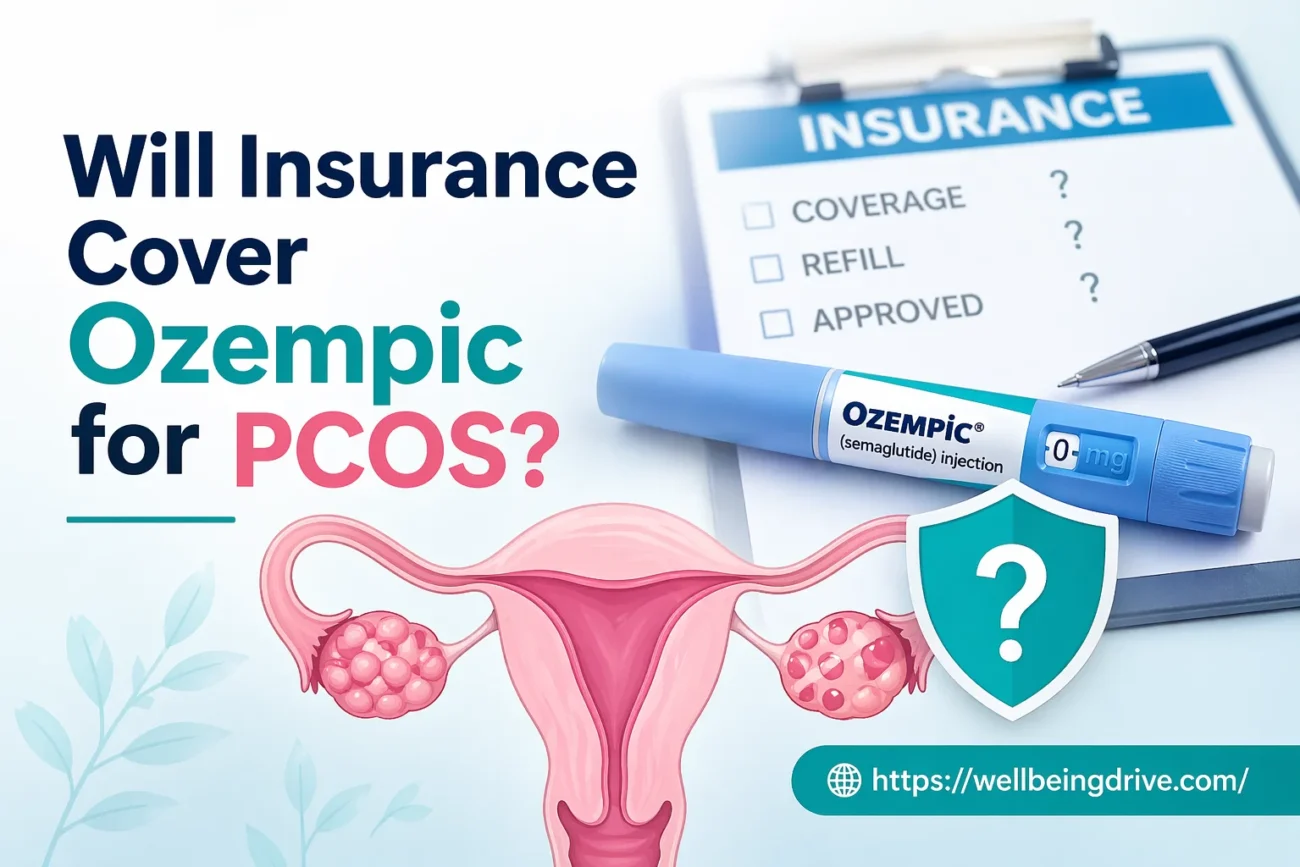
Most insurance plans will not cover Ozempic when PCOS is listed as the sole reason for the prescription. That is the starting point and it is worth knowing clearly before you spend time on hold with your insurer.
The reason is not that your doctor is wrong to consider it, and it is not that the drug does not work for PCOS — the research increasingly suggests it does. The reason is purely regulatory. Ozempic is FDA-approved for Type 2 diabetes, cardiovascular risk reduction in diabetic patients, and kidney disease management in people with diabetes. It is not approved for PCOS. Insurers base most coverage decisions on approved indications, so off-label prescriptions start from a disadvantaged position.
Coverage is unlikely if PCOS is your only diagnosis. It becomes possible when PCOS co-exists with Type 2 diabetes, obesity with BMI 30 or above, or obesity with a weight-related condition at BMI 27 or above. The documentation your doctor submits can make the difference between approval and denial — even within the same insurance plan.
Why the FDA Approval Gap Matters So Much
Ozempic’s generic name is semaglutide. It belongs to a class of drugs called GLP-1 receptor agonists, which work by mimicking a hormone your gut naturally produces after eating. That hormone signals the pancreas to release insulin, tells the liver to slow glucose production, and sends satiety signals to the brain. For people with Type 2 diabetes these effects are precisely what is needed.
For women with PCOS the appeal is connected but slightly different. Around 60 to 80 percent of women with PCOS have some degree of insulin resistance — even those who are not overweight. When insulin resistance is high, insulin levels climb, and elevated insulin drives the ovaries to produce excess testosterone. That excess testosterone is behind many of the most disruptive PCOS symptoms: irregular periods, excess hair growth, acne, and difficulty managing weight.
A drug that improves insulin sensitivity and reduces circulating insulin could address a root driver of PCOS. Endocrinologists and gynaecologists have understood this for years, which is why prescribing has increased dramatically. Research from Truveta found that semaglutide or tirzepatide prescribing in women with PCOS rose from 2.4 percent in 2021 to 17.6 percent in 2025 — a sevenfold increase in four years.
None of that changes the FDA picture. Novo Nordisk has not submitted Ozempic for approval in PCOS. Until that changes, PCOS remains off-label territory for this drug, and insurers treat off-label territory with significant financial caution.
Off-label prescribing is legal and common — doctors prescribe drugs for non-approved uses routinely. But insurance coverage does not automatically follow. Most plans cover medications for their approved indications only. When a drug is prescribed off-label, the insurer can and typically will decline unless the patient has an additional qualifying diagnosis or the plan specifically allows off-label use with prior authorization.
When Coverage Actually Becomes Possible
The practical answer for most women with PCOS is not a flat no — it is that coverage depends on what else is going on in your medical history. Three specific situations shift the odds meaningfully.
The insurance landscape for GLP-1 drugs shifted hard. Industry data shows 68 percent of commercial insurers eliminated weight-loss-only coverage in 2024 and 2025. Independence Blue Cross removed weight-loss coverage for 8.5 million members in January 2025. UnitedHealthcare denies 89 percent of weight-loss-only prior authorization requests. If your plan question is about weight loss rather than diabetes, the environment is considerably harder than it was two years ago.
What the Research Actually Shows
Understanding the evidence matters for two reasons. It helps you have a more informed conversation with your doctor, and it gives your doctor stronger material for a prior authorization or appeal letter.
A 2023 study found that low-dose semaglutide at 0.5 mg weekly produced meaningful weight loss in close to 80 percent of obese women with PCOS who had not responded to lifestyle changes alone. That weight loss came with improvements in fasting insulin, insulin resistance markers, and menstrual cycle regularity. A 2024 meta-analysis in the Journal of Diabetes and Complications found GLP-1 receptor agonists associated with significant reductions in BMI, waist circumference, triglycerides, and total testosterone compared to placebo in women with PCOS.
Testosterone levels — the driver behind many of the most visible PCOS symptoms — also fell meaningfully in clinical trials. The gap between what clinicians observe and what insurance policy reflects is real and genuinely frustrating. That gap is the core of why so many women with PCOS find themselves in coverage limbo right now.
How the Prior Authorization Process Works
Prior authorization — often called PA — is the formal process through which your doctor asks your insurer to approve a specific drug before it is dispensed. For Ozempic in a PCOS context this is not optional. Even when coverage is theoretically available under a qualifying secondary diagnosis, the insurer requires prior authorization before paying.
| Step | What Happens | Typical Timeline | Where It Can Stall |
|---|---|---|---|
| 1. PA Request Filed | Your doctor submits a prior authorization request with diagnosis codes and clinical rationale | Day 1 | Request filed under PCOS code only — immediately denied |
| 2. Insurer Reviews | Insurance medical staff checks whether the submitted diagnosis qualifies under formulary coverage rules | 7 to 14 days | Missing secondary diagnosis such as T2D or documented obesity |
| 3. Step Therapy Required | Many plans require proof that lower-cost drugs like metformin were tried first and were insufficient | Days to weeks depending on records | No documented treatment history with alternatives |
| 4. Approval or Denial | Insurer issues a written decision | Up to 21 days total | Denial due to off-label use or incomplete documentation |
The documentation your doctor includes is the single most influential factor in whether the PA is approved. A request listing PCOS alone will almost certainly be denied. One that documents Type 2 diabetes or qualifying obesity — with lab results, BMI measurements, and a clear medical necessity argument — has a reasonable chance.
If a patient has a BMI over 30, or over 27 with at least one weight-related health condition, some insurers will approve coverage after a prior authorization process that documents medical necessity and failed attempts with other therapies.
Dr. Suzanne Manzi, MD — board-certified obesity medicine physician, Performance Pain and Sports Medicine, HoustonWhat to Do After a Denial
A denial is not the end. It is the start of a different process. Insurance appeals for Ozempic succeed in roughly 30 to 50 percent of cases when properly supported — that is potentially thousands of dollars in annual savings if the appeal works.
- Request the written denial letter — you are legally entitled to a specific stated reason
- Ask your doctor to write an enhanced medical necessity letter that directly addresses the reason for denial
- Gather lab results showing insulin resistance, elevated testosterone, or metabolic markers
- Document all prior treatments tried and why they were insufficient — metformin, lifestyle changes, other medications
- Ask your doctor to request a peer-to-peer review — a direct call between your physician and the insurer’s medical director, which substantially improves approval rates
- Include peer-reviewed research on GLP-1 use in PCOS in your appeal package — the PubMed literature is publicly accessible
- If the appeal is denied again, request an external independent review
The peer-to-peer review option is worth knowing about because patients are rarely told it exists. When your doctor speaks directly with the insurance company’s medical director, the approval rate climbs meaningfully compared to a paper appeal alone. Not every practice has capacity to schedule these — ask your doctor specifically whether they are willing to make that call.
What Ozempic Costs Without Insurance
If coverage is denied and you are weighing paying out of pocket, the numbers are significant but not as extreme as they were a year ago.
| Pricing Pathway | Monthly Cost | Who Qualifies |
|---|---|---|
| List price (no assistance) | ~$968 | Anyone paying cash without discounts |
| Novo Nordisk introductory self-pay | $199 first 2 months | New US self-pay patients, 0.25 mg and 0.5 mg doses only |
| Novo Nordisk standard self-pay | $349/month ongoing | All self-pay patients after introductory period |
| Manufacturer savings card | As low as $25/month | Commercially insured patients with any partial coverage, valid up to 48 months |
The Novo Nordisk savings card is available through NovoCare and pharmacies working directly with Novo Nordisk including CVS, Costco, and telehealth platforms like GoodRx, Ro, and eMed. If your insurance provides any partial coverage at all, the $25 savings card can bring your out-of-pocket cost to a manageable level even when the plan does not cover the full amount.
Novo Nordisk’s Patient Assistance Program provides Ozempic at no cost to patients who cannot afford it and do not have insurance coverage. Eligibility is income-based. You can apply through NovoCare online or by calling 1-844-668-6463. If you qualify, the medication may be provided free of charge.
Medicare, Medicaid and Employer Plans
Coverage rules differ significantly by insurance type. Knowing where your plan sits helps clarify what is actually negotiable.
For women on employer-sponsored plans, it is worth checking whether your specific plan changed coverage terms in 2024 or 2025. Plans that previously covered GLP-1 medications for weight management may have dropped that coverage entirely. If you received prior approval and are now being denied for no apparent reason, a plan-level formulary change is likely why — not anything about your own situation.
The most direct route to clarity is calling the member services number on your insurance card and asking three specific questions: Does my plan cover semaglutide for Type 2 diabetes? Does it cover it for obesity or weight management? What documentation is required for prior authorization? Write down the answers and the name of the representative.
Frequently Asked Questions
Most plans will not cover Ozempic when PCOS is the only listed diagnosis because it is not FDA-approved for that condition. Coverage becomes more possible when PCOS co-exists with Type 2 diabetes, obesity with a BMI of 30 or higher, or BMI of 27 or above alongside a documented weight-related health condition. In those cases the insurer may approve Ozempic under an approved indication while it simultaneously benefits your PCOS.
Ozempic is FDA-approved only for Type 2 diabetes management, cardiovascular risk reduction in diabetic patients, and kidney disease protection in people with diabetes. It is not approved for PCOS. Insurance companies base most coverage decisions on FDA-approved indications, so prescribing it for PCOS alone is off-label use — which most plans will not reimburse without an additional qualifying diagnosis.
Coverage is meaningfully more likely when PCOS is accompanied by Type 2 diabetes (the strongest and most reliable pathway), obesity with a BMI of 30 or higher, or BMI of 27 or above with a documented weight-related condition such as high blood pressure, cardiovascular risk, or dyslipidaemia. Your doctor’s documentation and how they frame the medical necessity case matters as much as the underlying conditions themselves.
Ozempic’s list price is approximately $968 per month without assistance. Novo Nordisk offers a self-pay introductory price of $199 for the first two months for new US patients on lower doses, with ongoing pricing at $349 per month. A manufacturer savings card can reduce costs to as little as $25 per month for commercially insured patients with any partial coverage, valid for up to 48 months. A Patient Assistance Program is available for low-income patients at no cost.
Yes, and it is worth pursuing. Appeals succeed in approximately 30 to 50 percent of cases with proper documentation. A strong appeal includes a detailed medical necessity letter from your doctor, evidence of failed alternatives like metformin, lab results showing insulin resistance or metabolic markers, and peer-reviewed research on semaglutide’s benefits in PCOS. Asking your doctor to request a peer-to-peer review with the insurer’s medical director significantly improves outcomes.
Medicare Part D covers Ozempic only for its FDA-approved Type 2 diabetes indication. It does not cover it for weight loss or PCOS. A CMS rule proposed in late 2024 would have allowed Medicare Part D to cover weight-loss drugs starting with plan year 2026, but that portion was not included in the final rule published in April 2025. Coverage for PCOS alone remains unavailable under Medicare.
Medical Disclaimer: This article is for informational purposes only and does not constitute medical or insurance advice. Coverage decisions depend on your specific plan, your diagnoses, and your insurer’s current formulary. Always consult your prescribing physician and contact your insurer directly for decisions specific to your situation. Drug pricing information is sourced from Novo Nordisk announcements and GoodRx. Clinical research references are drawn from peer-reviewed sources including PubMed.
Disclaimer: WellbeingDrive provides health information for educational purposes only. Do not use this content as a substitute for professional medical advice. Consult your doctor before making health related decisions.