
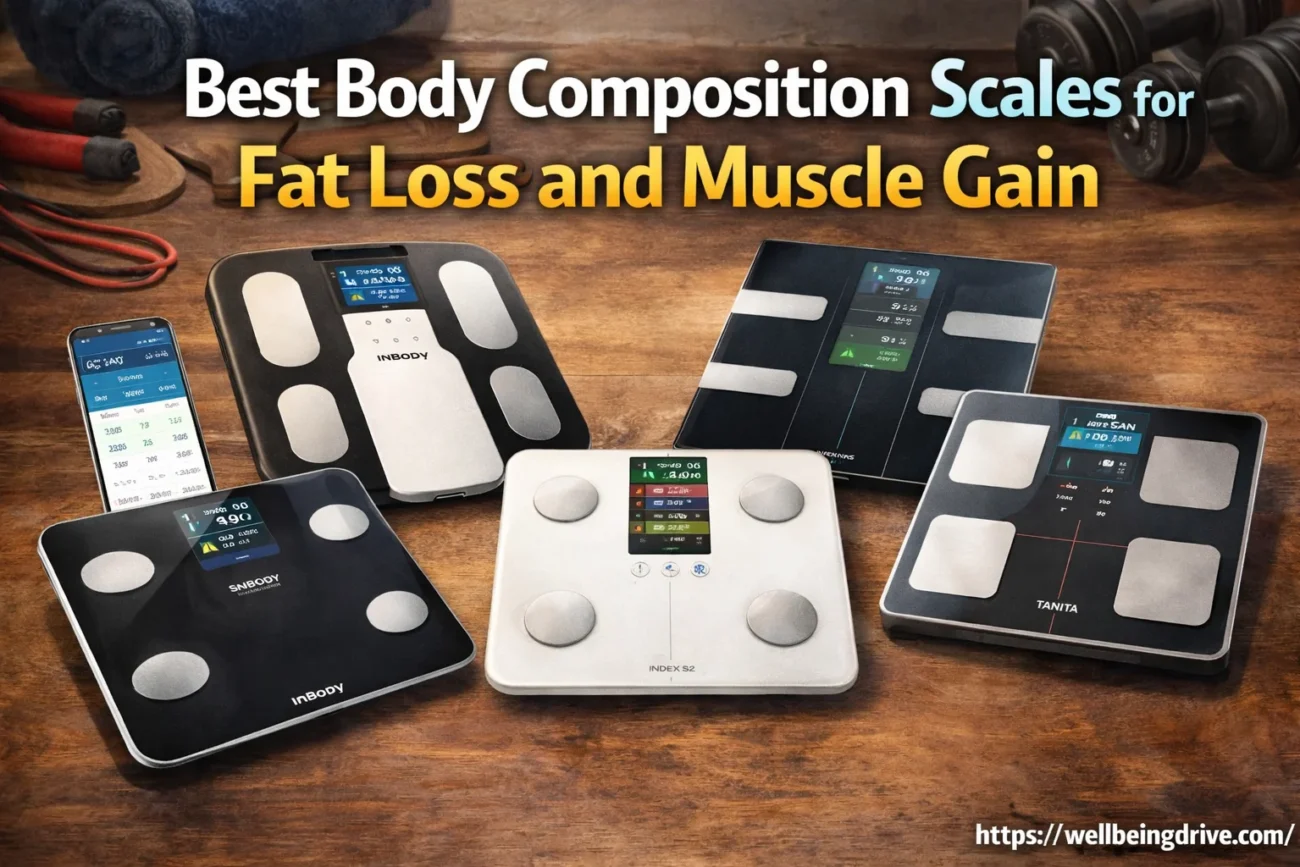
Stepping on a traditional bathroom scale tells you one thing: your total weight. That number can’t tell you if you’re losing fat, building muscle, holding extra water, or any combination of these. This becomes a real problem if you’re working toward body recomposition—losing fat while gaining muscle at the same time.
Body composition scales solve this by using bioelectrical impedance analysis (BIA). BIA sends safe electrical signals through your body and measures resistance to estimate how much of your weight comes from muscle, fat, water, and bone. The market now includes everything from budget-friendly Bluetooth models to medical-grade devices that used to be available only in hospitals.
This guide walks through five leading body composition scale brands that serve different needs and budgets. You’ll find options for daily home tracking, serious athletic monitoring, and everything in between. Each one includes a free companion app for long-term progress tracking.
How to Select the Best Body Composition Scale for Fat Loss and Muscle Gain
We researched these brands in March 2026 by reviewing manufacturer specifications, independent product testing, clinical validation studies, and thousands of customer reviews from major retail platforms.
Here’s what separates a good scale from a great one:
- BIA Technology Type: Single-frequency BIA is common but less precise; multi-frequency BIA captures more detail and works better for athletes or anyone with above-average muscle mass.
- Electrode Configuration: Four electrodes (feet only) measure whole-body averages; eight electrodes (hands and feet) break down readings by limb and trunk for segmental analysis.
- Metrics Tracked: Look for scales that measure body fat percentage, skeletal muscle mass, visceral fat, and basal metabolic rate (BMR)—not just weight and BMI.
- App and Ecosystem Integration: A well-built companion app with trend tracking, goal setting, and compatibility with platforms like Apple Health or Google Fit makes daily use easier.
- User Profiles and Multi-User Support: Automatic user recognition lets households or training partners share one scale without manual profile switching every time.
List of the Best Body Composition Scales for Fat Loss and Muscle Gain
These five brands represent the top options across different technology levels and price points:
- InBody
- Withings
- RENPHO
- Garmin
- Tanita
Best Body Composition Scales for Balancing Fat Loss and Muscle Gain
1. InBody
- Technology: Direct Segmental Multi-frequency BIA using 8 electrodes; measures each body segment independently without relying on age, gender, or ethnicity assumptions
- Consumer Models: InBody Dial H20 and InBody Dial H30; multi-frequency analysis across three frequencies sent through eight electrodes; up to 20 users with automatic recognition
- Key Metrics: Weight, skeletal muscle mass, body fat mass, percent body fat, visceral fat level, soft lean mass, waist-hip ratio, upper/lower body balance, BMR, BMI, and InBody Score
- Connectivity: Bluetooth sync to InBody App; compatible with Apple Health, Google Fit, and Samsung Health; FSA/HSA eligible
- Awards and Recognition: IF Design Award 2025 (Communication and Apps/Software); CES Innovation Honoree 2024 (Sports & Fitness); Forbes Asia’s Best 200 Under $1 Billion 2024; used by NASA’s Johnson Space Center
InBody made its name supplying professional-grade analyzers to hospitals, research labs, corporate wellness programs, and elite training facilities around the world. NASA’s Johnson Space Center uses InBody devices for astronaut monitoring. The consumer-facing InBody USA body composition scale models—the Dial H20 and H30—bring that same clinical measurement approach home. Direct segmental multi-frequency BIA means the scale measures each body part separately instead of estimating from overall resistance. This matters because it skips the demographic assumptions that other scales build into their calculations. The result sheet format stays simple enough to read whether you’re chasing fat loss, muscle gain, or both at once.
Best For: Serious fitness enthusiasts and athletes who want clinical-grade segmental body composition data at home without demographic-based estimation errors.
Standout Feature: Direct segmental multi-frequency BIA using 8 electrodes and 3 frequencies—the same measurement methodology used in professional and clinical InBody devices, not a consumer-grade approximation of it.
2. Withings
- Founded: 2008; headquartered in France; known for award-winning design and connected health devices including scales, watches, thermometers, and sleep trackers
- Flagship Model: Body Comp; uses multi-frequency bioimpedance analysis; price $229.95; FSA/HSA eligible; European Medical Device Regulation (MDR) Class IIa certified
- Key Metrics: Weight (±0.1 lb precision), body fat percentage, total body water, muscle mass, bone mass, visceral fat, vascular age, standing heart rate, Electrodermal Activity (EDA) Score, and BMR
- Connectivity: Wi-Fi and Bluetooth sync to Withings Health Mate app; compatible with Apple Health, Google Fit, Samsung Health, Fitbit, and 100+ partner apps; up to 8 users with auto recognition; 15-month battery life
- Unique Measurements: Vascular Age (an indicator of arterial health); Electrodermal Activity Score (nerve health via sweat gland stimulation in feet)—the first consumer scale to combine body composition, cardiovascular, and nerve health metrics in one device
Withings entered the connected health market in 2008 and built a reputation for sleek, medically validated devices. Body Comp earned European MDR Class IIa medical device certification, placing it in the same regulatory category as certain clinical instruments. The scale combines body composition tracking with cardiovascular and nerve health readings. Vascular Age estimates arterial health, while the Electrodermal Activity Score checks nerve function through sweat gland response in your feet. No other consumer scale offers these metrics. Weight precision hits ±0.1 lb, and the Health Mate app connects with more than 100 third-party platforms.
Best For: Health-conscious users who want a medically certified scale that tracks body composition alongside cardiovascular and nerve health indicators.
Standout Feature: Vascular Age and Electrodermal Activity Score—exclusive metrics not available on any other consumer scale, making Body Comp the first device to combine body composition, cardiovascular health, and nerve health assessment in a single step-on measurement.
3. RENPHO
- Technology: BIA (Bioelectrical Impedance Analysis) with 4 high-sensitivity electrodes; step-on technology; auto calibration; 5mm tempered glass platform
- Key Metrics: 13 body composition measurements including weight, BMI, body fat percentage, body water, muscle mass, bone mass, BMR, protein, visceral fat, skeletal muscle, subcutaneous fat, metabolic age, and body age
- Capacity: 400 lbs / 180 kg maximum weight capacity; measures in 0.2 lb / 0.05 kg increments; unlimited user profiles; baby and pet weighing mode included
- Connectivity: Bluetooth 4.0; free RENPHO Health App (iOS and Android); syncs with Apple Health, Google Fit, Samsung Health, Fitbit, and MyFitnessPal; Apple Watch compatible; FSA/HSA eligible
- User Base: Over 50 million users of the RENPHO Health App globally; 1-year limited manufacturer warranty
RENPHO operates one of the most-used body composition tracking apps on the market, with more than 50 million users worldwide. The Elis 1 and similar models track 13 body composition metrics through BIA technology and wireless Bluetooth syncing. What stands out is the breadth of platform compatibility. The app connects with Apple Health, Fitbit, Google Fit, Samsung Health, and MyFitnessPal—covering nearly every major health and fitness ecosystem. Unlimited user profiles make it practical for families or shared living situations where multiple people want to track their own data.
Best For: Budget-conscious individuals and families who want a widely compatible, easy-to-use scale with a comprehensive 13-metric app at an accessible price.
Standout Feature: Compatibility with five major health platforms (Apple Health, Google Fit, Samsung Health, Fitbit, and MyFitnessPal) alongside an app used by over 50 million people globally—offering the broadest third-party health integration of any scale in this guide.
4. Garmin
- Model: Index S2 Smart Scale; price $149; available in black or white; dimensions 320 x 310 x 28 mm; weight 4.4 lbs; supports up to 400 lbs / 181 kg
- Technology: BIA (Bioelectrical Impedance Analysis); weight precision within 0.1 kg; color OLED display; weather forecast shown on display
- Key Metrics: Weight, body fat percentage, BMI, skeletal muscle mass, bone mass, body water percentage, and 30-day weight trend (displayed directly on scale)
- Connectivity: Wi-Fi auto-sync to Garmin Connect account (no phone required at weigh-in); Bluetooth backup; supports up to 7 saved Wi-Fi networks; up to 16 user profiles with auto-recognition; 9-month battery life on 4 AAA batteries
- Ecosystem: Designed for Garmin Connect ecosystem—body composition data appears alongside activity, sleep, training load, and recovery data; can be used with Garmin Connect app alone without a Garmin watch
The Garmin Index S2 was built for people already living in the Garmin Connect ecosystem. Body composition data syncs automatically over Wi-Fi and appears next to your activity, sleep, training load, and recovery metrics in one unified view. Weight precision reaches within 0.1 kg, and the color OLED display shows your data clearly from standing height. You don’t need to pull out your phone when you step on. The scale remembers up to 16 user profiles with automatic recognition and stores connection details for seven different Wi-Fi networks.
Best For: Garmin watch owners who want body composition data integrated seamlessly into their existing Garmin Connect training, sleep, and recovery data.
Standout Feature: Full Wi-Fi auto-sync to Garmin Connect with no phone required—body composition data appears automatically alongside all other Garmin health and training metrics, making it the most frictionless option for existing Garmin users.
5. Tanita
- Founded: 1923 in Tokyo, Japan; introduced the world’s first integrated body composition analyzer/scale to the professional market in 1992 and first consumer body fat monitor/scale in 1994; recognized as the inventor of BIA technology
- Flagship Consumer Model: RD-953 InnerScan PRO—FDA-cleared dual-frequency BIA; world’s first consumer Bluetooth scale with multi-frequency BIA technology; 440 lb / 200 kg capacity; 4-user memory with auto-recognition
- Key Metrics: 11 measurements—weight, body fat, muscle mass, Muscle Quality Score, physique rating, bone mass, visceral fat, daily caloric intake (DCI), metabolic age, total body water, and BMI
- Unique Feature: Muscle Quality Score—a proprietary metric that assesses not just the quantity of muscle mass but the quality and condition of muscle tissue, rated in three categories (High, Standard, Low), particularly valuable for users over 30
- Connectivity: Bluetooth to free Healthy Edge Mobile App (iOS and Android, including Amazon Fire); color-coded LCD display on scale; Athlete Mode for users with high muscle mass and atypical hydration
Tanita started making precision scales in 1923 and invented BIA-based body composition analysis. The company launched the first consumer body fat scale in 1994, creating the product category that every other brand in this guide now competes in. The RD-953 InnerScan PRO holds FDA clearance for dual-frequency BIA and was the first consumer Bluetooth scale to use multi-frequency technology. Its standout feature is the Muscle Quality Score, which rates the condition and contractile capacity of your muscle tissue in three levels: High, Standard, or Low. This metric becomes especially useful for strength athletes and anyone over 30 tracking age-related muscle quality changes.
Best For: Strength training athletes and users over 30 who want to monitor both muscle mass quantity and muscle tissue quality over time, with the most historically validated BIA technology available.
Standout Feature: Proprietary Muscle Quality Score—the only consumer scale metric that assesses the quality and condition of muscle tissue rather than mass alone, developed by the inventor of consumer BIA body composition analysis.
Factors to Consider When Choosing a Body Composition Scale
BIA Technology Level
Multi-frequency BIA captures both intracellular and extracellular water, giving you a more complete picture of body composition changes. Single-frequency BIA uses one electrical frequency and tends to be less precise, especially for athletes or people with higher muscle mass. Scales limited to single-frequency BIA can underestimate muscle growth and overestimate fat loss because they miss details about water distribution inside and outside your cells.
Electrode Configuration and Segmental Analysis
Scales with four electrodes (feet only) measure total body resistance and estimate your overall composition. Scales with eight electrodes (both hands and feet) measure each limb and your torso separately, producing segmental readings. Segmental analysis matters if you do unilateral training—like single-leg exercises or one-arm work—or if you want to track muscle development in specific body parts over time.
Athlete Mode and Body Type Adjustments
Standard BIA algorithms assume average hydration levels and muscle mass for general adult populations. Athletes or highly active people with above-average muscle and different hydration patterns can get inaccurate readings on scales without adjustments. Look for a dedicated Athlete Mode that recalibrates the measurement equations to account for these differences.
App Quality and Data Longevity
Your scale is only as useful as the app storing your data. Prioritize apps that show long-term trend graphs, let you export your data, and connect with the fitness platforms you already use. Historical data becomes your most valuable asset after several months of consistent tracking. An app that makes it easy to see patterns over time will keep you engaged longer than one that only shows today’s numbers.
Measurement Consistency Conditions
BIA readings shift based on hydration level, recent meals, exercise, and time of day. Your scale can show different results morning versus evening even if your actual body composition hasn’t changed. Always weigh yourself under identical conditions: same time each day, before eating, after using the bathroom, and ideally before your first drink of water. Consistent conditions produce comparable data and prevent misleading trends.
Final Thoughts
The real value of a body composition scale for fat loss and muscle gain comes from consistent use under identical conditions. Track your changes over weeks and months rather than obsessing over daily fluctuations. The exact numbers matter less than the direction your metrics move.
If body recomposition is your main goal, choose a scale that measures skeletal muscle mass and visceral fat alongside total body fat percentage. These metrics tell you far more about what’s happening inside your body than weight or BMI alone.
Match your scale to the fitness ecosystem you already use. If you’re tracking workouts and nutrition in a specific app or wearing a particular brand of fitness tracker, picking a compatible scale removes friction and makes long-term tracking easier to sustain.
Disclaimer: WellbeingDrive provides health information for educational purposes only. Do not use this content as a substitute for professional medical advice. Consult your doctor before making health related decisions.