
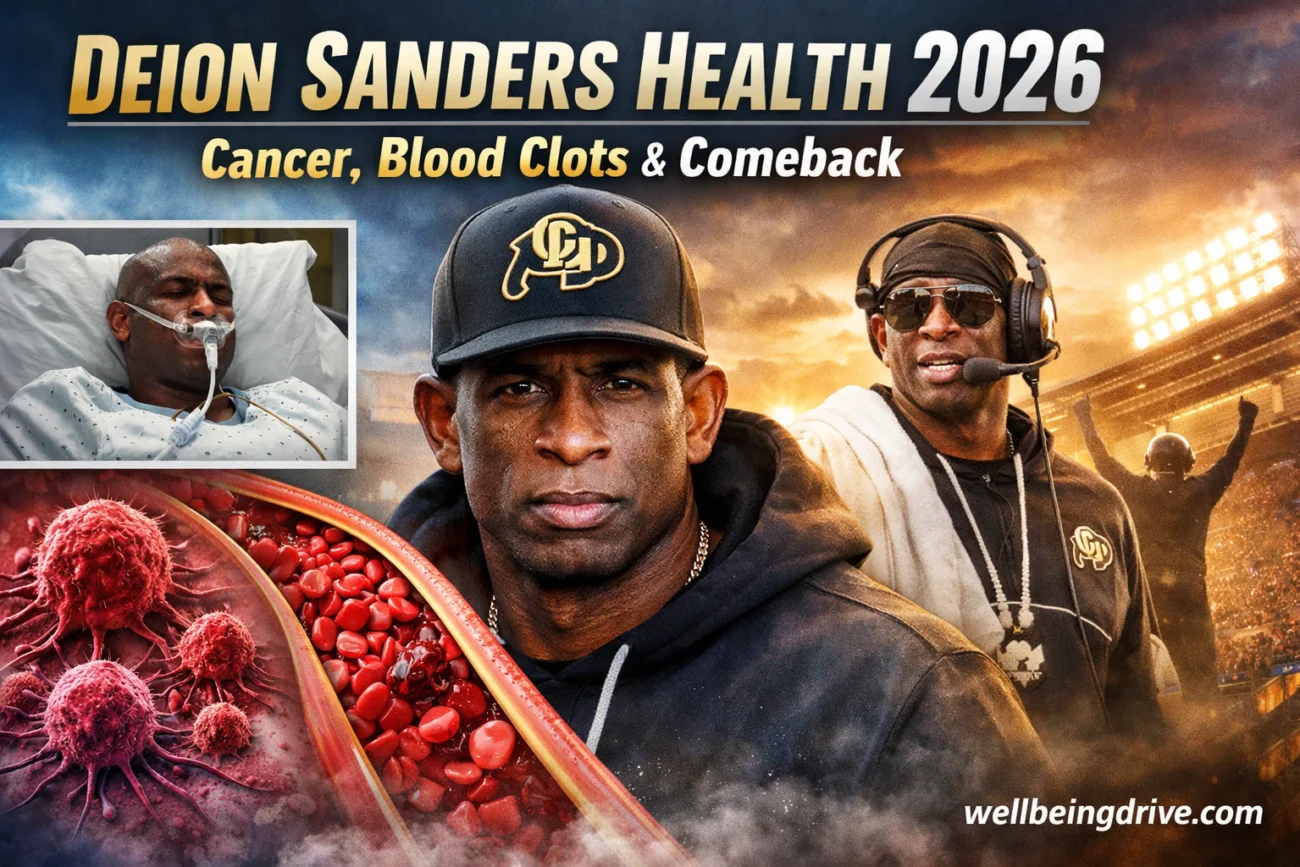
Deion Sanders Health: The Full Story Behind the Blood Clots, the Amputations, and the Cancer He Beat
Coach Prime has fought through 14 surgeries, a near leg amputation, chronic vascular disease, and bladder cancer. He kept most of it private, even from his own sons. Here is the complete picture of what happened and where he stands today.
As of 2026, Deion Sanders is cancer-free following complete bladder removal and reconstruction in 2025. He continues to manage chronic vascular disease and returned to the sidelines to coach the Colorado Buffaloes for the 2025 season. This was his 14th surgery since 2021.
Where It All Started: A Routine Surgery That Changed Everything
The story does not begin with cancer. It begins with a football coach’s foot and a surgery that should have been unremarkable. In September 2021, while coaching at Jackson State University, Deion Sanders went under the knife to address what appeared to be a straightforward foot issue.
What followed was anything but straightforward. Within days, his situation turned life-threatening. The foot surgery triggered a cascade of complications that would set off years of medical battles and permanently alter how Sanders moves through the world.
Understanding that first crisis in full is the key to understanding everything that came after.
The Blood Clot Crisis: Three Clots, 23 Days in the ICU, Two Toes Gone
After his foot surgery, Deion Sanders developed three femoral arterial blood clots in his left leg, located between his knee and ankle. These clots blocked circulation to his lower leg and foot, starving the tissue of oxygen and nutrients.
The resulting condition was compartment syndrome — a medical emergency in which pressure builds to dangerous levels within the muscle compartments, cutting off blood supply. Doctors had to cut open his leg to drain fluid and relieve the pressure. What had started as foot surgery became a race to save his leg, and at certain points, his life.
They were talking about the amputation of toes. Then they were talking about the amputation of my leg from the knee down. Then, they were trying to ensure I had life.
Deion Sanders, Coach Prime documentary seriesSanders spent 23 days in a Mississippi hospital, the majority of that time in the intensive care unit. He had eight surgical procedures during that stay. He lost between 35 and 40 pounds. He needed help getting in and out of bed.
When the ordeal was finally over, his big toe and second toe on his left foot had been amputated. A significant skin graft marked each side of his leg. He spent the remainder of the 2021 season in a wheelchair, coaching from the sideline at Jackson State.
Surgical procedures in a single hospital stay.
Sanders endured eight operations during his 23-day stay in a Mississippi ICU in 2021 alone, before the longer series of follow-up procedures that followed over the next four years.
Doctors feared the worst at multiple points. As Sanders recalled his conversation with his mother during that hospital stay, the family history that nobody had spoken about suddenly became relevant in the most alarming way.
I called my mother and said, ‘Ma, do we have a history of blood clots?’ She said, ‘Yeah, I have blood clots and, by the way, your uncle passed away a few years ago from blood clots.’ I said, ‘Well thanks, Mom. I really appreciate that.’
Deion Sanders, Good Morning AmericaCompartment syndrome occurs when pressure within a closed muscle compartment rises to dangerous levels. It blocks blood flow, oxygen, and nutrients from reaching nerves and muscles. Without emergency intervention, it can cause permanent muscle death, nerve damage, or loss of a limb. It is considered a medical emergency requiring immediate surgery.
Years of Ongoing Vascular Problems
The 2021 crisis did not mark the end of his vascular troubles. It marked the beginning of an ongoing medical chapter that Sanders has been managing ever since. Chronic vascular disease does not resolve with a single surgery. It requires continued monitoring, procedures, and lifestyle management.
In 2023, Sanders underwent an extensive nine-hour surgery at UCHealth in Colorado. Imaging had revealed aneurysms and blood clots in his upper thigh, near his groin. Surgeons also worked to straighten his remaining toes, which were curling and rubbing painfully against his shoe. The goal was simple but significant: allow him to walk, and eventually run, without pain.
UCHealth orthopedic specialists even worked with Nike to design custom orthotic footwear that could accommodate the anatomy of his left foot following the amputations. Sanders had one clear ambition after the surgery.
I just wanted to run out before my team, like coaches do.
Deion Sanders, UCHealthEven after that surgery, blood clots continued to recur. In October 2025, during Colorado’s football season, Sanders went public about needing an aspiration thrombectomy — a procedure to remove clots from his left popliteal and tibial arteries. He delivered the update matter-of-factly at a weekly press conference.
I cannot wait to get past this hurdle. It’s hereditary and has nothing to do with me working at the level I’m trying to compete at.
Deion Sanders, October 2025 press conferenceBladder Cancer: Found by Accident During a Routine Scan
In April 2025, Sanders went in for his annual CT scan. He goes every year specifically because of his history with blood clots and chronic vascular disease. It is a monitoring scan, not a diagnostic one. He had no symptoms. Nothing felt wrong.
The scan came back with good news on the vascular side. Then, two weeks later, his primary care doctor called and told him the urologist needed to see him. A tumor had been found in his bladder.
The tumor was examined and the results were serious. It was a high-grade, non-muscle-invasive bladder cancer that had already begun to invade through the bladder wall. Without surgery, the cancer carried a 50% chance of progressing into the muscle layer, at which point survival rates drop sharply.
The bad side of this cancer is that if it does progress to the muscle, the rate of metastasis is about 50%. Only about 10% of people live more than five years, even with our current medical treatment if it metastasized. We are very lucky to have found it at this stage where I can say the word cure, because I don’t use that word lightly as a cancer doctor.
Dr. Janet Kukreja, Director of Urologic Oncology, University of Colorado AnschutzSanders had two choices. He could undergo repeated intravesical treatments to try to manage the cancer within the bladder, but those carry high recurrence rates with high-grade tumors. Or he could have his bladder surgically removed entirely. That would mean a longer, harder recovery but the best shot at a cure.
He chose removal. And he kept the whole thing to himself.
The Surgery: Bladder Removed, a New One Built from His Intestine
In May 2025, Deion Sanders underwent a radical cystectomy — the complete surgical removal of his bladder — performed by Dr. Kukreja using robotic surgical techniques. The procedure was his 14th surgery since his blood clot ordeal began in 2021.
Surgeons then reconstructed a new bladder using a section of his small intestine. This process, known as a neobladder reconstruction, creates a reservoir that allows relatively normal urinary function over time, though recovery is lengthy and demanding.
The post-surgical pathology results showed no remaining cancer. Dr. Kukreja was able to use a word she acknowledged she does not use lightly.
I am pleased to report that the results from the surgery are that he is cured from the cancer.
Dr. Janet Kukreja, July 28, 2025 press conference, Boulder, ColoradoThe surgery left Sanders 25 pounds lighter and dealing with ongoing challenges related to urinary function as his body adapted to the reconstruction. He recovered at his 5,000-acre estate in Canton, Texas, absent from the Colorado campus for nearly three months.
Post-surgical results confirmed no traces of cancer. Dr. Kukreja declared Sanders cured on July 28, 2025. He returned to Boulder the Friday before that announcement and met with his team, players, and coaching staff before going public with the full story.
What Is Bladder Cancer? The Medical Facts Behind His Diagnosis
Bladder cancer is the 10th leading cause of cancer death in the United States. The American Cancer Society estimates roughly 85,000 new cases in the United States in 2025, with more than 65,000 occurring in men. More than 90% of cases occur in people over 55.
Sanders was 57 at the time of his diagnosis. His case illustrates several points that cancer specialists frequently raise about this particular disease:
- Bladder cancer can be completely asymptomatic in its early stages. Discolored urine is often the first warning sign, but not always present.
- High-grade non-muscle-invasive bladder cancer carries a significant recurrence risk if managed conservatively without bladder removal.
- When caught before it reaches the muscle layer, surgical cure is achievable. Dr. Kukreja’s willingness to use the word “cured” was itself significant.
- Smoking is the single largest risk factor. Other contributors include chemical exposure, catheter use, and certain workplace environments.
- Men are diagnosed at roughly four times the rate of women, making routine screening conversations with doctors particularly important for men over 50.
What made Sanders’ case notable medically was the tumor’s aggression combined with the early stage at detection. Had it not been found during his vascular monitoring scan, it almost certainly would have progressed further before being discovered.
Bladder cancer affects roughly 85,000 Americans annually. Over 90% of cases are diagnosed in people over 55. When caught before reaching the muscle layer, surgical outcomes are significantly better. Death rates have declined approximately 1% per year since 2013, largely attributed to reduced smoking rates. Source: National Library of Medicine
Why He Kept It Secret, Even from His Sons
One of the more striking aspects of Sanders’ health story is how deliberately he shielded the people closest to him from the full picture. His sons, Shedeur and Shilo, were preparing for the 2025 NFL Draft during the months he was dealing with his cancer diagnosis and surgery. His star player Travis Hunter was also navigating the draft process.
Sanders made a deliberate choice not to tell them the details. He told them it was a foot issue again. He changed his cellphone number more than once to control who could reach him.
My sons, to this day, don’t know what transpired. I just told them it was something with my foot again because I wanted them to focus on making the team and not be focused on dad.
Deion Sanders, July 28, 2025 press conferenceThe only person who knew the full scope of what was happening was his youngest son, Deion Sanders Jr., who accompanied him through surgeries and treatments and documented parts of the journey on his digital channels. In one emotional video, Sanders reflected on having made a will for his family in May 2025.
Sanders said he went public specifically to push others to see their doctors. “We are helping some folks today. There’s some folks right now calling their doctors, scheduling checkups,” he said at the press conference. His surgeon echoed that intent, noting the case demonstrates exactly why routine scanning matters.
Current Status: Cancer-Free, Still Coaching, Still Fighting Vascular Disease
Sanders returned to Boulder in late July 2025, began the season, and led Colorado into the 2025 campaign. He was back on the sideline for fall camp and the season opener against Georgia Tech on August 29.
But chronic vascular disease does not go away. In October 2025, just weeks into the season, Sanders needed another procedure for blood clots in his left leg — the aspiration thrombectomy targeting the popliteal and tibial arteries. He was coaching again the next day.
His attitude toward the ongoing medical management is characteristically Sanders: direct, faith-driven, and entirely unwilling to step aside.
I’m back, baby.
Deion Sanders, upon returning to Boulder, July 2025As of 2026, he holds a contract extension running through 2029 with an annual salary of approximately $10 million. His two sons, Shedeur with the Cleveland Browns and Shilo with the Tampa Bay Buccaneers, are in the NFL. Sanders is entering a new coaching chapter — without his sons on the roster, without Travis Hunter in the backfield, but apparently with his health, at least for now, on his side.
What His Journey Actually Teaches Us
Strip away the celebrity and the Coach Prime brand, and what remains is a story about the kind of medical dominoes that can fall from a single surgery complication — and how early detection, even when it happens by accident, can be the difference between a curable cancer and a fatal one.
Sanders did not go looking for his bladder cancer. He went in for his vascular scan, the same one he has every year because of his blood clot history. The cancer appeared in the frame of a scan aimed at something else entirely. That is not luck in the conventional sense. That is the direct result of being monitored consistently over time.
- Routine scans for existing conditions can catch unrelated cancers before symptoms appear.
- Family history of blood clots is a meaningful risk factor worth disclosing to doctors.
- High-grade bladder cancer treated before muscle invasion carries a genuinely good prognosis.
- Chronic vascular disease requires long-term management, not a single fix.
- Compartment syndrome following surgery is a rare but life-threatening emergency that demands immediate attention.
Sanders said it himself in the simplest terms at his July 2025 press conference. “You have no idea how good God has been to me, for me to be here. You have no idea.”
FAQs
Deion Sanders has battled severe blood clots, compartment syndrome, the amputation of two toes on his left foot, ongoing chronic vascular disease, and an aggressive bladder cancer diagnosis in 2025. His bladder was surgically removed and reconstructed from his small intestine. His doctors have declared him cured of the cancer as of July 2025.
No. As of July 2025, his surgeon Dr. Janet Kukreja publicly declared him cured following complete surgical removal of his bladder. Post-surgical pathology results showed no traces of cancer remaining. He continues to have ongoing monitoring for chronic vascular disease, but his bladder cancer is considered resolved.
In 2021, Sanders developed three femoral arterial blood clots in his left leg following foot surgery. The clots caused compartment syndrome, cutting off blood flow to his lower leg and toes. Doctors amputated his big toe and the second toe on his left foot to save his leg and prevent further life-threatening complications. Doctors initially feared they might need to amputate from below the knee.
The tumor was found during a routine annual CT scan in April 2025, a scan Sanders has every year because of his chronic vascular disease and blood clot history. He had no symptoms at the time. The scan was not looking for cancer — it found cancer by monitoring something else, which is a strong argument for regular health screenings even when you feel fine.
Yes. Sanders returned to coach the Colorado Buffaloes for the 2025 season following his bladder removal surgery. He has a contract extension through 2029. He also underwent a further blood clot procedure in October 2025 and returned to the sideline the following day. As of 2026, he is actively coaching and considered cancer-free.
Medical Disclaimer: This article is written for informational and educational purposes only. All health information is sourced from publicly available statements, verified news reports, official press conferences, and medical institutions including UCHealth and the University of Colorado Anschutz Medical Campus. This article does not constitute medical advice. Always consult a qualified healthcare professional for personal health concerns.
Disclaimer: WellbeingDrive provides health information for educational purposes only. Do not use this content as a substitute for professional medical advice. Consult your doctor before making health related decisions.