
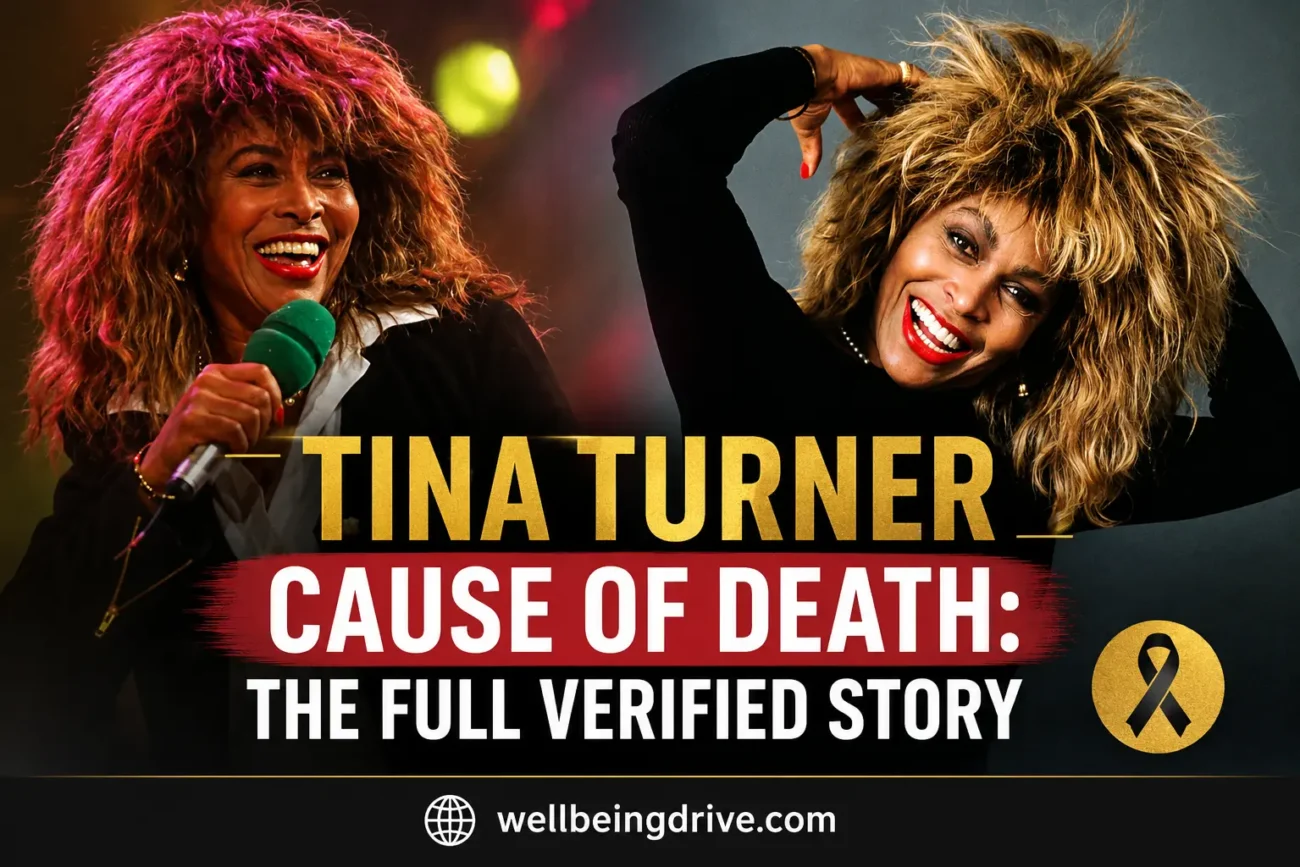
Tina Turner Cause of Death: The Full Story of Her Final Decade
She died on May 24, 2023, at 83. Her team confirmed natural causes. But behind that phrase was a ten-year medical journey she had documented herself, in her own words, with unusual candour.
Tina Turner did not leave her health story for others to tell. Over seven years, across interviews, a documentary, and a memoir she wrote with characteristic directness, she laid out what had been happening to her body since 2013. The result is one of the most thoroughly documented celebrity health journeys of the past decade, and one of the most honest.
When her team announced her death on May 24, 2023, the phrase “natural causes after a long illness” was enough for most headlines. For anyone who had followed her own account, it was simply the final chapter of a story she had already told in full.
What Happened on May 24, 2023
“Tina Turner, the Queen of Rock’n’Roll has died peacefully today at the age of 83 after a long illness in her home in Küsnacht near Zurich, Switzerland. With her, the world loses a music legend and a role model. With her music and her inexhaustible vitality, Tina Turner thrilled millions of fans and inspired many artists of subsequent generations.”
The following day, her representatives confirmed to Daily Mail that the official cause of death was natural causes. Her publicist told NBC News the death came after a long illness. No further clinical detail was released by her family or estate.
She died at her home in Küsnacht, a quiet lakeside municipality near Zurich, where she had lived since the 1990s. She had relocated to Switzerland permanently, eventually becoming a Swiss citizen in 2013. Her husband Erwin Bach was with her.
As NPR reported on the day of her death, Turner had detailed her health struggles extensively in her 2018 memoir, and her passing came after a decade of compounding medical conditions that began with a stroke in 2013.
Her Health Timeline: 2013 to 2023
What makes Tina Turner’s final decade significant from a medical perspective is that multiple serious conditions intersected and compounded each other. No single illness was the cause of death in isolation. The decade-long cascade began with a stroke and ended with a body that had been through treatments most people half her age would have struggled with.
- 1978 High Blood Pressure Diagnosed Turner was diagnosed with hypertension and began daily medication in 1985. She later wrote that she assumed her persistently high readings were simply normal for her body. The decades of inadequately managed blood pressure would later devastate her kidneys.
- Oct 2013 Stroke Three months after marrying Erwin Bach, Turner suffered a stroke. She described the experience in detail in her memoir. She was hospitalised for 10 days and required extensive rehabilitation to regain the ability to walk.
- 2014–2015 Kidney Function Declining Post-stroke tests revealed her kidneys were functioning at only 35 percent capacity. Her initial choice to pursue homeopathic therapies rather than conventional treatment allowed the damage to progress further. Kidney function eventually dropped to 5 percent, requiring dialysis.
- Jan 2016 Intestinal Cancer Diagnosed After months of chronic diarrhea, Turner was diagnosed with intestinal cancer. Carcinoma and multiple malignant polyps were found at an early stage. Surgery was performed in February 2016 to remove the affected section of intestine.
- Late 2016 Cancer All Clear A follow-up colonoscopy returned a cancer-free result. Turner described this as miraculous given the severity of what she had been through. The result cleared the path for her kidney transplant.
- Apr 2017 Kidney Transplant Turner received a donated kidney from her husband Erwin Bach. The surgery was successful. She later described it as the moment that saved her life and gave her years she would not otherwise have had.
- 2018 My Love Story Published Turner published her memoir documenting every major health event since 2013 in precise and honest detail. It became the primary verified source for understanding the full scope of her medical history.
- May 24, 2023 Died Peacefully in Switzerland Tina Turner died at her home in Küsnacht near Zurich, age 83. Cause of death confirmed as natural causes following a long illness. Her husband Erwin Bach was present.
The Stroke That Started Everything
In October 2013, three months after her marriage to Erwin Bach, Tina Turner suffered a stroke. She had been living with untreated high blood pressure since 1978. The stroke was the first acute consequence of that long-term damage to her cardiovascular system.
She described the experience in her 2018 memoir with the kind of precision that comes from having processed something frightening into something she could control through language.
I woke up suddenly and in a panic. A lightning bolt struck my head and my right leg — at least that’s how it felt — and I had a funny sensation in my mouth that made it difficult for me to call out to Erwin for help. I suspected it wasn’t good, but it was worse than I ever imagined. I was having a stroke.
Tina Turner — My Love Story (2018)She spent 10 days in hospital. When she was discharged, she discovered she could not walk unaided. Rehabilitation was slow and physically demanding. She eventually recovered her ability to walk, but the neurological consequences of the stroke, combined with the pre-existing cardiovascular damage from decades of high blood pressure, had lasting effects on her overall health.
After the stroke, her doctors identified that her kidneys had been severely compromised by the long-term hypertension. Her blood pressure had not simply been uncomfortably high. It had been silently destroying the filtration capacity of her kidneys for decades, unnoticed because her symptoms were attributed to other causes. Understanding how cardiovascular conditions create compounding physical symptoms is relevant context for understanding why Turner’s seemingly manageable blood pressure became catastrophic over time.
Kidney Failure and the Decision That Changed Everything
The Initial Diagnosis
After her stroke, Turner’s doctors confirmed her kidneys were functioning at only 35 percent capacity. The prognosis without intervention was serious. What happened next was a decision Turner herself described as her greatest medical regret.
Instead of immediately beginning the conventional treatment her doctors recommended, she chose homeopathic therapies. She documented this in her memoir without defensiveness but also without illusion. The homeopathic treatment did not halt the kidney decline. By the time she accepted conventional medical intervention, her kidney function had dropped to 5 percent. She required dialysis to stay alive.
The Transplant
In April 2017, Turner underwent a kidney transplant. The donor was Erwin Bach, her husband. He was a compatible match and chose to donate without hesitation. She wrote about this in her memoir with a mixture of gratitude and awareness of how it would be perceived.
I wondered if anyone would think that Erwin’s living donation was transactional in some way. Incredibly, considering how long we had been together, there were still people who wanted to believe that Erwin married me for my money and fame.
Tina Turner — My Love Story (2018)The transplant was successful. Turner gained years of life she would not otherwise have had. The experience is documented in Today’s comprehensive account of her health history, drawn directly from her memoir. Chronic kidney disease of the kind Turner experienced is closely linked to long-term cardiovascular damage, and the progression she described — from hypertension to organ failure — reflects a well-documented clinical pathway. For those understanding how organ systems deteriorate together, the signs of progressive organ disease offer useful comparison context.
Intestinal Cancer Diagnosis in 2016
While managing the aftermath of her stroke and declining kidney function, Turner received a second major diagnosis in January 2016. She had been experiencing chronic diarrhea for months. Investigation revealed intestinal cancer — carcinoma and multiple malignant polyps in the small intestine.
The Surgery
In February 2016, she underwent surgery to remove the affected section of her intestine. The cancer had been caught at a relatively early stage. Doctors believed it could be cured, though complete certainty was not possible until follow-up testing.
The surgery created a conflict with her kidney transplant plans. Proceeding with both simultaneously was not possible. The cancer surgery took priority, pushing her kidney transplant back by a full year, during which her kidney function continued to deteriorate.
The All Clear
By late 2016, a colonoscopy returned a cancer-free result. Turner wrote in her memoir: “Miraculously, I received a diagnosis of ‘all clear.'” That result opened the door to proceeding with the kidney transplant in 2017.
Her son Ronnie Turner, her biological child with Ike Turner, died in December 2022 from metastatic colon carcinoma at age 63, less than six months before his mother’s death. The proximity of both deaths, and both involving intestinal cancers, has been noted by medical observers, though there is no publicly confirmed evidence of a genetic link diagnosed in Tina Turner herself.
What She Said About It All
Tina Turner did not speak about her health struggles for sympathy. She spoke about them because she believed her story had value to people going through similar experiences, and because silence about the body’s failures felt dishonest to her.
In her memoir, she summarised the cumulative nature of what she had been through with typical directness: “I’ve been on such a wild roller-coaster in the four years since my wedding that even I have difficulty keeping my medical catastrophes straight.”
On the subject of dying itself, she had spoken with unusual peace. In an interview with Oprah Winfrey conducted years before her death, she said something that reads differently now than it did then.
“I’m not excited to die, but I don’t regret it when it’s time for me. I’ve done what I came here to do. Now is pleasure. I’ve got great friends. I have a great man in my life now. I have a great husband and I’m happy.”
She also spoke openly about her PTSD from her years with Ike Turner, her early suicidal thoughts, and her eventual decision that she was “meant to survive.” In her 2021 documentary Tina, she said of her first marriage: “It wasn’t a good life. The good did not balance the bad. I had an abusive life. There’s no other way to tell the story. It’s a reality. It’s a truth.”
The public conversation around celebrity health and cause of death often erases the person behind the headlines. Turner’s memoir prevents that. For readers who follow the coverage of other celebrities whose health journeys have been similarly documented and similarly misrepresented, the coverage of David Arnold’s cause of death offers a useful comparison in how these stories are reported and what gets lost.
Confirmed vs Unconfirmed
Online coverage of Tina Turner’s death has included some claims that go beyond what was officially confirmed. This grid separates what is verified from what is not.
A Life on Her Own Terms
Tina Turner spent the last decade of her life in Switzerland, largely out of the public eye, managing a sequence of serious medical conditions that would have exhausted most people half her age. She did it with her husband beside her, with the financial means to access excellent care, and with a degree of self-awareness about her own medical choices — including the ones that made things harder — that is rare among people who live their lives at her level of visibility.
The phrase “natural causes” covers a great deal. In Turner’s case it covered a stroke, kidney failure, a transplant, intestinal cancer, decades of cardiovascular damage, and the cumulative toll of a body pushed for sixty years through performance demands that would be extraordinary for anyone. She documented all of it herself so that no one would have to guess.
She had said years before her death that she had done what she came to do. The record she left behind, in music and in memoir, confirms it. Her death was the end of a long illness. Her life was something else entirely.
Disclaimer: This article is for informational purposes only. All health details about Tina Turner are drawn exclusively from her own public statements, her memoir My Love Story (2018), her 2021 documentary Tina, and verified reporting from NBC News, NPR, and Today.com. No independent medical claims are made about her health. The official cause of death as confirmed by her representatives was natural causes following a long illness.
Frequently Asked Questions
Tina Turner’s official cause of death was confirmed as natural causes by her representatives on May 25, 2023. Her publicist described her death to NBC News as the result of a long illness. No further clinical detail was officially released by her family or estate beyond those two phrases.
Yes, and she was candid about it in her memoir. After her 2013 stroke she initially chose homeopathic treatment rather than the conventional care her doctors recommended. She later described this as a decision that allowed her kidney damage to worsen significantly. She ultimately accepted conventional dialysis and a transplant in 2017, which she credited with saving her life.
Intestinal cancer is a rare malignancy of the small intestine. Turner was diagnosed in January 2016 after months of chronic diarrhea. Her cancer was found at an early stage — carcinoma and multiple malignant polyps. Surgery in February 2016 removed the affected section, and a late 2016 colonoscopy returned an all clear result. The surgery delayed her kidney transplant by a year.
Chronically high blood pressure damages the small vessels inside the kidneys that filter waste from blood. Over decades, this damage reduces filtration efficiency progressively. Turner was diagnosed with hypertension in 1978 and managed it from 1985, but her kidney function still deteriorated severely, eventually falling to 5 percent before her transplant. She attributed the kidney failure directly to decades of inadequately controlled blood pressure.
Tina Turner’s husband Erwin Bach, a German music executive she had been with since 1986 and married in 2013, donated one of his kidneys in April 2017. Turner wrote in her memoir that she initially worried some would question his motives. She rejected those doubts and credited the donation with giving her years she would not otherwise have had.
Yes. In her memoir she was direct that her choice to pursue homeopathic treatments after her 2013 stroke, rather than immediately accepting conventional medication, allowed her kidney damage to progress further than it otherwise might have. She documented it without defensiveness, treating it as a hard lesson rather than a failure.
In an interview with Oprah Winfrey conducted years before she died, Turner said: “I’m not excited to die, but I don’t regret it when it’s time for me. I’ve done what I came here to do. Now is pleasure. I’ve got great friends. I have a great man in my life now. I have a great husband and I’m happy.” The statement reflected the peace she had found in her final years in Switzerland.
Disclaimer: WellbeingDrive provides health information for educational purposes only. Do not use this content as a substitute for professional medical advice. Consult your doctor before making health related decisions.