
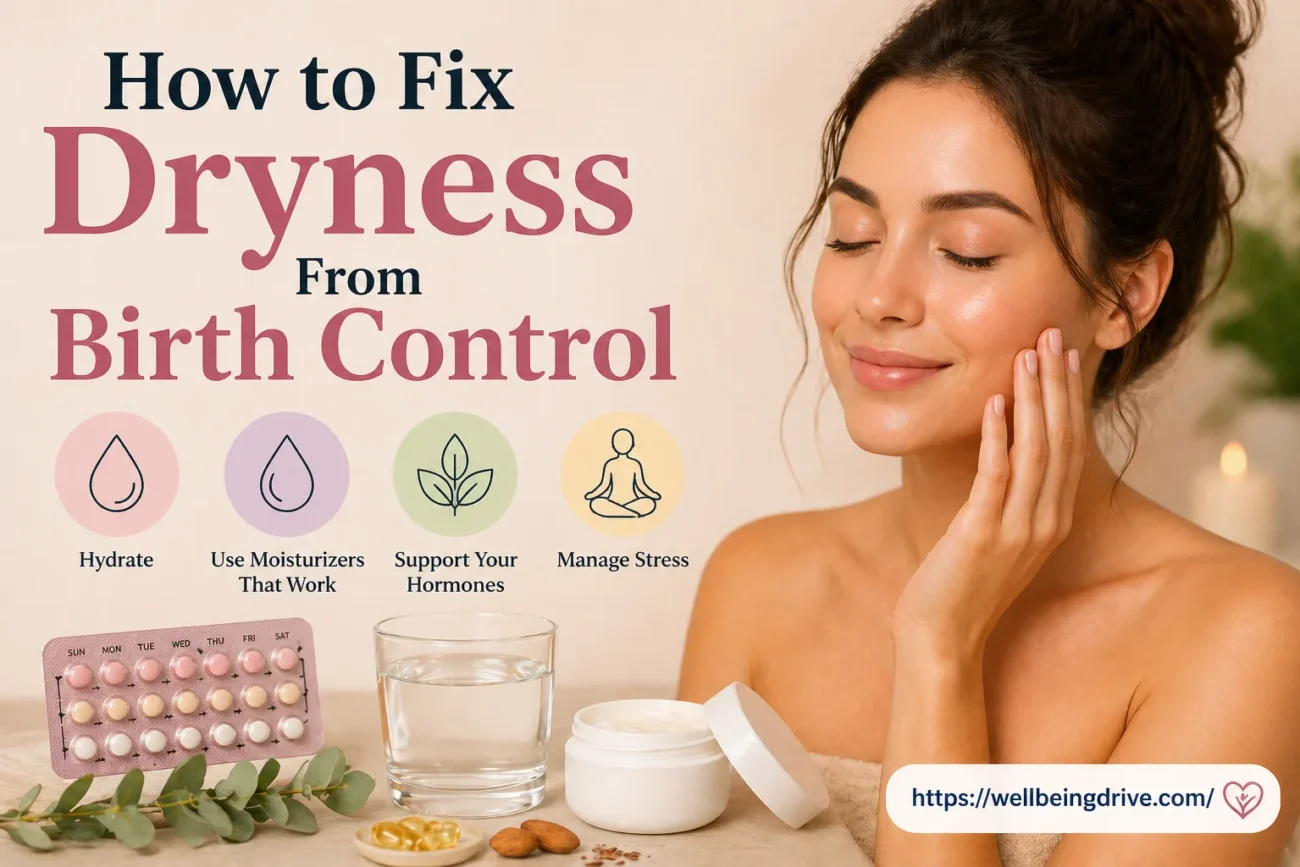
How to Fix Dryness From Birth Control: What Actually Helps and What to Ask Your Doctor
Vaginal dryness is one of the most common reasons women quietly discontinue their birth control — and one of the least discussed in the consultation room. If your contraception is making you uncomfortable, there are real options that do not involve simply putting up with it.
Why Birth Control Causes Dryness — the Actual Mechanism
Natural vaginal moisture depends on oestrogen. It is oestrogen that keeps vaginal tissue thick, elastic, and well-lubricated. When oestrogen levels drop — which is exactly what most hormonal contraceptives are designed to do, to varying degrees — the tissue responds. Less oestrogen means thinner, drier, more sensitive tissue.
A comprehensive systematic review published in the Journal of Clinical Medicine confirmed that hormonal contraceptive use decreases circulating oestrogen, androgens, and progesterone, as well as inhibiting oxytocin function. These are not fringe effects — they are built into how the contraception works. Suppressing the hormonal environment that enables pregnancy also suppresses the hormonal environment that maintains natural lubrication.
A 2023 study added another layer: oral contraception reduces blood flow to the genitals. Arousal-based lubrication is partly a vascular response — increased blood flow to vaginal tissue produces the natural wetness that comes with arousal. Reduced blood flow means reduced lubrication even when arousal is present, which explains why some women find that desire is intact but their body’s response has changed.
This is not your libido failing you and it is not a sign that something is medically wrong. It is a physiological response to hormone suppression — one that affects a significant minority of women on hormonal contraception and one that has documented, practical solutions. You are not stuck with it.
Which Birth Control Methods Are Most Likely to Cause It
Not all contraception carries the same dryness risk. The hormone type, dose, and delivery method all influence how significantly vaginal tissue is affected.
| Method | Hormones Involved | Dryness Risk |
|---|---|---|
| Progestin-only pill (mini-pill) | Progestin only — suppresses oestrogen more directly | Higher Risk |
| Hormonal IUD (Mirena, Kyleena) | Localised progestin — suppresses systemic oestrogen | Higher Risk |
| Depo-Provera (shot) | Progestin injection — significantly lowers oestrogen | Higher Risk |
| Implant (Nexplanon) | Progestin — suppresses oestrogen | Moderate Risk |
| Combined pill (standard dose) | Oestrogen + progestin — oestrogen component partially offsets dryness | Moderate Risk |
| Patch / Vaginal ring | Oestrogen + progestin | Moderate Risk |
| Copper IUD (Paragard) | No hormones — purely mechanical barrier | No Hormonal Dryness |
| Condoms / Diaphragm / Fertility awareness | No hormones | No Hormonal Dryness |
The pattern here is clear: methods that rely primarily or entirely on progestin — without oestrogen to counterbalance — are the most likely to produce significant dryness. If you are on a progestin-only method and experiencing dryness, the hormone profile of your contraception is the most direct cause.
Lubricants — Picking the Right One for the Right Situation
Lubricants address dryness at the point of use — during sexual activity. They are the fastest, lowest-barrier solution and the right starting point for most women. But the type matters significantly, both for effectiveness and for what you use for contraception.
Fragrances, parabens, glycerin (in some formulations), petroleum jelly, and warming or cooling additives are all common irritants for hormonally sensitive vaginal tissue. When tissue is already dry and thin from lower oestrogen, it becomes hypersensitive — products that caused no problems before may now produce burning or itching. Read labels. If it has a scent designed to make it pleasant, it probably does not belong near your vulva right now.
Vaginal Moisturisers — the Option Most People Do Not Know About
Lubricants are for use during sex. Vaginal moisturisers are different — they are used regularly, regardless of sexual activity, to maintain tissue health over time. Think of them the way you think of face moisturiser: a daily maintenance product rather than a situational one.
The best-evidenced ingredient in vaginal moisturisers is hyaluronic acid. A randomised clinical trial published in Menopause found that vaginal hyaluronic acid produced improvement in over 90 percent of participants after 12 weeks of use. The study concluded it was a promising non-hormonal alternative for managing vaginal dryness symptoms.
Vaginal moisturisers come in gel or suppository form and are inserted internally. They work by attracting moisture to vaginal tissue and maintaining it over several days per application. Brands like Replens, Yes VM, and hyaluronic acid-based products are widely available without prescription. They are not the same as lubricants and are not interchangeable — use the moisturiser for tissue health between activity, and a lubricant during.
Natural Remedies That Have Actual Evidence
Not all of the natural suggestions that circulate for vaginal dryness are well-supported. These three have published research behind them.
Your Hygiene Routine Might Be Making It Worse
When vaginal tissue is already sensitive from reduced oestrogen, the products and habits that seemed fine before can start causing real irritation. This is not about changing who you are — it is about removing friction from an already compromised environment.
- Stop using any soap inside the vagina. The vagina is self-cleaning. Internal washing with any product — including gentle soap — disrupts the natural pH and bacterial balance. Warm water only inside. Always.
- Switch to a pH-balanced, fragrance-free cleanser for the vulva. Brands specifically formulated for intimate use (BEPPY, Femfresh unscented, Yes Wash) are designed for this. Avoid anything with a scent, foam-boosting agents, or antibacterial claims.
- Check your laundry detergent. Synthetic fragrances in the detergent used for underwear are a surprisingly common irritant. Switch to a hypoallergenic, fragrance-free option for underwear specifically.
- Avoid douches entirely. Douching strips the natural bacterial environment that keeps the vagina healthy. There is no version of douching that is beneficial.
- Wear breathable cotton underwear. Synthetic fabrics trap heat and moisture in a way that worsens tissue sensitivity. Cotton allows airflow and reduces friction against already dry tissue.
- Skip scented pads, liners, and period products. Scented period products are in direct contact with sensitive tissue for extended periods. Unscented is always the better option, more so when tissue is already compromised.
When to Talk to Your Doctor — and What to Ask
Dryness from birth control sometimes resolves on its own within two to three months as the body adjusts. If it has been longer than that, or if the discomfort is significantly affecting your quality of life or sexual relationship, the conversation with your doctor is worth having.
What stops most women from having it is the same thing that stops most women from discussing vaginal health generally — a sense that it is either too minor to mention or too personal to raise. Leading experts in reproductive health have argued directly that discussing sexual dysfunction and vaginal symptoms when prescribing hormonal contraception should be part of informed consent. You are not raising a trivial complaint. You are using information your doctor needs to help you make the right contraceptive choice.
Be specific. Tell your doctor which method you are on, how long the dryness has been present, whether it is persistent or only during sex, and whether it comes with other symptoms like itching or burning. Ask: Is a higher-oestrogen combined pill a better option for me? Would topical low-dose oestrogen cream help? Is there a non-hormonal alternative that would suit my needs? The CDC’s 2024 contraceptive guidelines emphasise that contraceptive choices should be guided by a shared decision-making process that includes discussion of side effects. Use that process.
For women with significant or persistent dryness, a prescription topical oestrogen product — cream, ring, or suppository — applied directly to vaginal tissue restores local oestrogen without meaningfully affecting systemic hormone levels. This can be used alongside your current contraception. It is well-established in the treatment of vaginal atrophy and has been used for decades. Your GP or gynaecologist can assess whether it is appropriate for you.
Considering Switching Your Contraceptive Method
If dryness is persistent and significantly affecting your life, it is worth having a frank conversation about whether your current method is the right one for your body. The best contraception is the one you can tolerate comfortably and use reliably — one that makes you miserable is not serving you well.
Whatever you decide, the goal is contraception that works for your body, not just a prescription that looks the same on paper for every patient. If your current method is making you physically uncomfortable on a regular basis, you are entitled to explore alternatives — and Healthline’s medical review of birth control and vaginal dryness covers the full range of options clearly if you want to go into that conversation better prepared.
For a broader clinical overview of vaginal dryness causes and treatments across different life stages, the American College of Obstetricians and Gynecologists guidance on painful sex includes specific sections on hormonally driven dryness and the full spectrum of treatment approaches available.
Frequently Asked Questions
Yes. Hormonal contraceptives — including the pill, patch, ring, shot, implant, and hormonal IUD — can lower oestrogen, androgen, and progesterone levels, reducing natural vaginal lubrication. A 2023 study also found that oral contraception reduces blood flow to the genitals, further affecting natural moisture even when arousal is present. Non-hormonal methods like the copper IUD and condoms do not cause hormonal dryness.
For mild dryness: use a water-based or silicone-based lubricant during sex, apply a vaginal moisturiser with hyaluronic acid two to three times weekly, switch to fragrance-free hygiene products, and stay well hydrated. For persistent dryness: talk to your doctor about switching pill formulation to a higher-oestrogen combined pill, changing your contraceptive method, or using a prescription topical low-dose oestrogen cream alongside your current contraception.
Sometimes. Hormonal side effects including dryness often improve within two to three months as the body adjusts to the new hormone levels. If dryness persists beyond three months or significantly affects your quality of life or sexual comfort, it is unlikely to resolve on its own. At that point a conversation with your doctor about adjusting your method or adding treatment is the right next step.
Non-hormonal methods — copper IUD, condoms, diaphragm, fertility awareness — do not cause hormonal vaginal dryness. Among hormonal methods, combined pills with a higher oestrogen component tend to cause less dryness than progestin-only pills, the hormonal IUD, or the shot. Individual hormone responses vary, which is why discussing side effects with your doctor before choosing or switching methods is important.
Yes. A randomised clinical trial published in Menopause found that vaginal hyaluronic acid produced improvement in over 90 percent of participants after 12 weeks. It works by attracting and retaining moisture in vaginal tissue and is available without prescription as a gel or suppository. It is a daily maintenance moisturiser — used regularly between sexual activity — rather than a lubricant used only during sex.
Yes, with one important caveat. A 2023 study confirmed sterile coconut oil is safe and effective as a vaginal lubricant. However, oil-based lubricants degrade latex condoms, reducing their effectiveness at preventing pregnancy and STIs. If you use latex condoms, choose a water-based or silicone-based lubricant instead. Coconut oil is fine with polyurethane condoms or when using non-condom contraception.
Medical Disclaimer: This article is for informational purposes only and does not constitute medical or gynaecological advice. Vaginal symptoms including dryness, itching, or burning can have multiple causes including infection and should be assessed by a qualified healthcare provider before beginning self-treatment. Always consult your doctor before changing your contraceptive method or adding any new treatment. Information sourced from Healthline and the American College of Obstetricians and Gynecologists.
Disclaimer: WellbeingDrive provides health information for educational purposes only. Do not use this content as a substitute for professional medical advice. Consult your doctor before making health related decisions.