
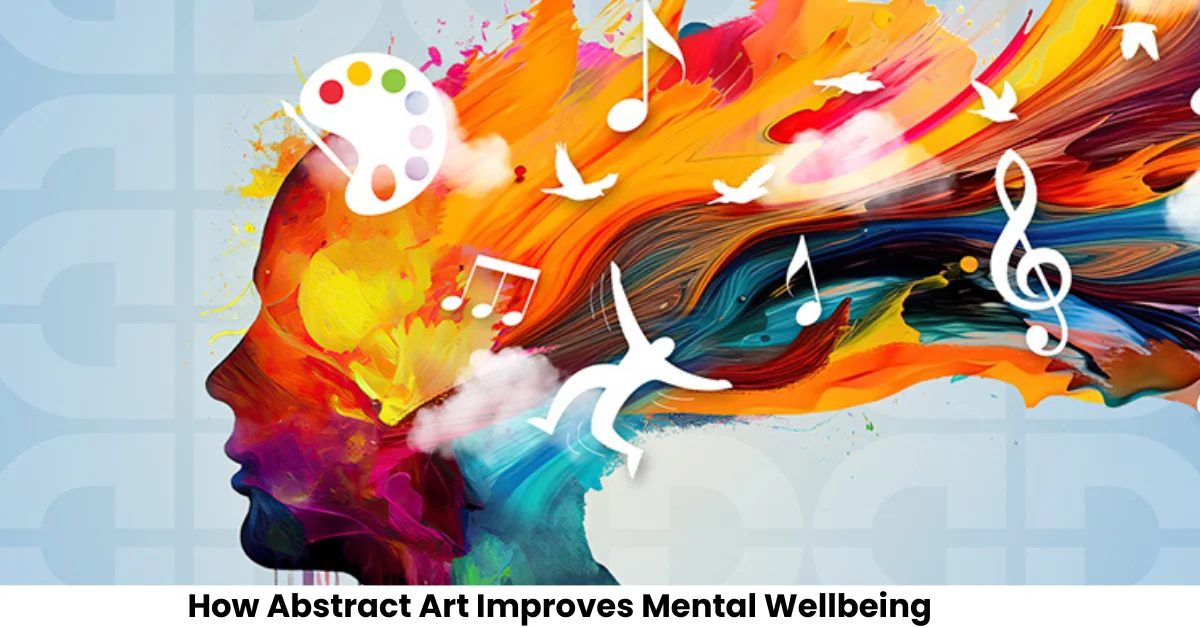
Walk into a room where a striking abstract painting hangs on the wall, and you feel it before you understand it. Something shifts — a softening, a spark of curiosity, a quiet settling. Most of us chalk that up to aesthetics. But science tells a more interesting story: the impact of art on how we feel is real, measurable, and worth paying attention to.
If you’ve been treating home decor as purely visual, this article is your invitation to think differently. Modern abstract paintings aren’t just beautiful objects. They are, when chosen thoughtfully, a genuine tool for everyday wellbeing.
What Are Modern Abstract Paintings? (A Quick Primer)
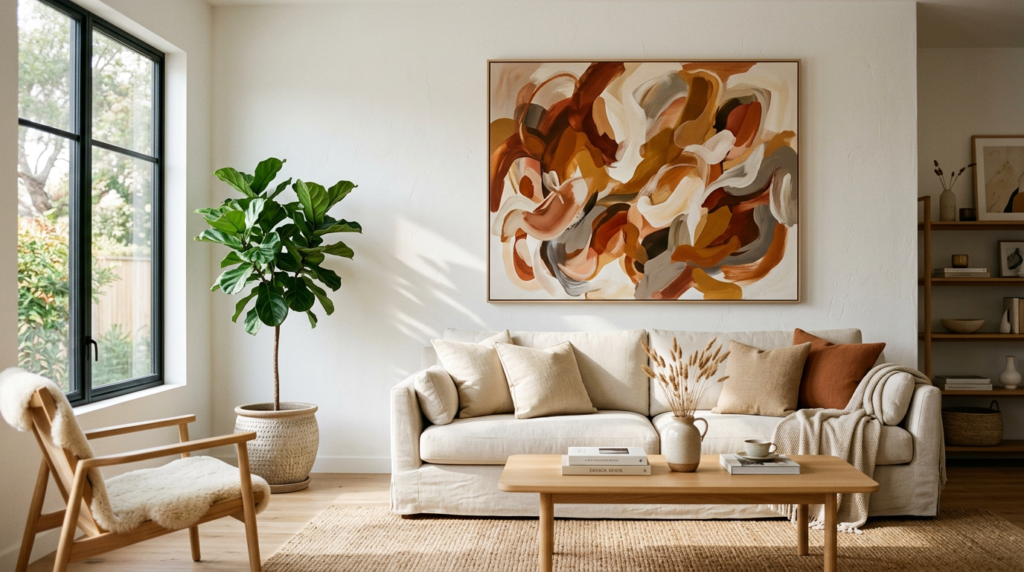
A living room with a large contemporary abstract painting in earthy tones hanging above a linen sofa
Abstract art is any work that doesn’t aim to represent the visible world realistically. Instead of a bowl of fruit or a portrait, you get shapes, color relationships, texture, and emotion — the inner world of the artist rendered visible.
“Modern art” loosely covers work from the late 19th century through the 1970s, but in everyday conversation (and in how we shop and search), it blends with “contemporary” to describe art that feels of the moment rather than classical. The major styles worth knowing:
- Abstract Expressionism — gestural, emotionally raw, think of Jackson Pollock’s drips or Mark Rothko’s luminous color fields
- Geometric Abstraction — precise shapes and symmetry, Mondrian’s grids, brings calm order to a busy space
- Color Field painting — large, flat areas of rich or muted color; deeply meditative and room-defining
- Contemporary Abstract — where most independent artists work today: blending texture, nature, personal narrative, and color into something entirely their own
The good news: you don’t need to know any of these labels to benefit from abstract art. You just need to notice how a piece makes you feel.
How to Choose Modern Art Paintings for Your Home
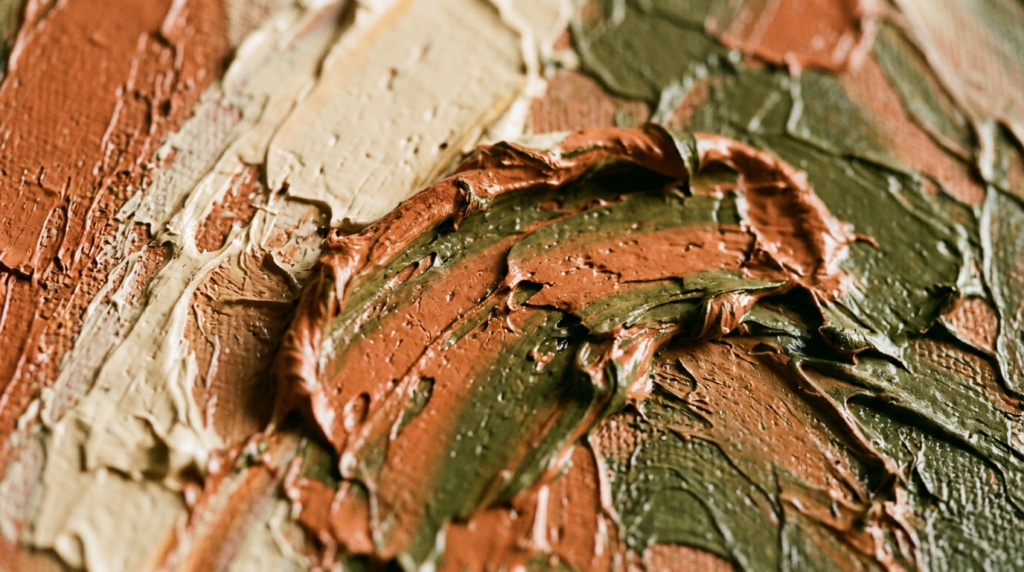
Close-up of an original abstract painting with visible textured brushstrokes in terracotta, cream, and deep olive
Buying art can feel intimidating, but the process becomes straightforward when you approach it the same way you approach other wellbeing choices — with intention and self-awareness.
- Start with your space: Modern, minimalist rooms suit geometric abstraction or color-field works. Warm, eclectic interiors welcome textured, nature-inspired pieces. Scandinavian and Japandi spaces pair beautifully with quiet, contemplative minimalism. Abstract art is unusually versatile — it rarely clashes the way representational pieces can.
- Know your mood intention: A calming bedroom calls for different energy than a creative studio. Think about how you want to feel in the room, then look for paintings that carry that feeling. Trust your gut: if you feel something in the first ten seconds, that’s the neuroscience doing exactly what it’s supposed to do.
- Get the scale right: A common mistake is buying too small. As a rule of thumb, artwork should span at least two-thirds the width of the furniture it hangs above. An undersized painting reads as an afterthought; a properly scaled one commands the room.
- Don’t overthink style matching: Designer Tara Bernerd puts it plainly: art doesn’t have to match your room. A bold abstract in a neutral space creates focus. A muted piece in a richly colored room creates breathing room. Contrast is a tool, not a problem.
- Let emotional resonance be your guide: The most important question isn’t “Does this go with my sofa?” It’s “Does this painting make me feel something worth feeling every day?” If the answer is yes, that’s your piece.
Original abstract paintings are more accessible than many people assume. If you’re ready to explore, browsing a curated collection of paintings modern art from an independent artist is an excellent starting point — works that carry genuine creative intent, not mass-produced reproduction energy.
The Science Behind Art and Wellbeing
The connection between art and mental health isn’t soft or anecdotal — it has a solid research foundation.
The World Health Organization’s Regional Office for Europe has formally recognized arts engagement as having measurable health benefits, reviewing over 3,000 studies in the process. A landmark BMC Public Health study found that people who engaged with the arts for 100 or more hours per year scored approximately two points higher on standardized wellbeing scales — a dose-response relationship, meaning the more art in your life, the better the effect.
On a neurological level, viewing art that moves you triggers the brain’s reward circuitry. Blood flow to pleasure-processing areas increases in ways comparable to seeing someone you love. Stress hormones tell a quieter story: cortisol levels can drop by 15–20% after an art-viewing experience. Research also suggests that arts engagement can reduce mental strain by nearly 30% — a meaningful number for anyone managing day-to-day anxiety or low-level burnout.
A 2025 study published in ScienceDirect added another dimension: arts participation significantly and positively influences both psychological well-being and emotional intelligence. The act of engaging with art — even passively, by living alongside it — appears to build our capacity to process and regulate emotion.
Abstract art specifically earns its place here because of what it doesn’t do: it doesn’t demand a particular interpretation. A painting of a mountain is a mountain. An abstract painting is an open question your brain gets to answer. That freedom is cognitively gentle and, for overstimulated minds, genuinely restful.
Why Abstract Paintings Work Especially Well at Home
A museum visit is a one-time event. A painting on your bedroom wall is a daily companion.
This distinction matters enormously from a well-being standpoint. The cumulative effect of living with art — glancing at it in the morning, pausing in front of it after a hard meeting, noticing a new detail on a quiet Sunday — builds over time. It’s not a single dose; it’s a sustained relationship with your environment.
Placement amplifies the effect. Hang a painting in the room where you spend the most time — your living room, bedroom, or home office — and it enters your visual field regularly. Bedrooms benefit from cooler, softer palettes: blue, sage, and muted lavender calm the nervous system. Home offices respond well to grounded, earthy tones or gentle geometric compositions that stimulate without overstimulating. Living rooms can handle bolder energy — a painting that anchors the room and gives guests something to feel, not just see.
Abstract paintings also function as mindfulness anchors. A two-to-three-minute practice of simply looking — really looking — at a piece in your home is a legitimate mindfulness exercise. No app required. You’re training your attention, shifting out of autopilot, and giving your mind a place to land that isn’t a screen.
For those managing anxiety or mood dips, the mood-redirecting quality of a compelling painting shouldn’t be underestimated. It provides what psychologists call positive distraction: a pull toward curiosity and beauty that interrupts cycles of negative rumination.
Making Art a Part of Your Daily Wellness Practice
The most powerful shift you can make is to stop thinking of a painting as a decoration and start thinking of it as a practice.
Each morning, before you reach for your phone, spend two minutes looking at the painting nearest to you. Not analyzing it — just seeing it. Notice what pulls your eye. Notice what you feel. This is a mindfulness practice as legitimate as any breathing exercise, and it costs nothing beyond the initial investment.
As seasons and moods change, consider rotating pieces between rooms. A painting that felt right in summer may ask to move in winter. This keeps your relationship with the work alive and prevents visual habituation — the way we stop seeing things that never change.
Art also doesn’t exist in isolation. It works in concert with natural light, living plants, decluttered surfaces, and intentional material choices. A well-chosen abstract painting is a meaningful anchor in a broader home wellness strategy.
And there’s a quieter benefit in buying from independent artists: you’re supporting a human creative practice, not a supply chain. The painting you live with carries the energy of someone who made something real. That meaning accumulates, too.
You don’t need a large budget or an art history degree to begin. You need a piece that speaks to you — one that earns a daily glance, shifts your mood in the right direction, and makes the room you live in feel more fully yours.
2025–2026 Trends That Align Perfectly With Wellness
What’s trending in modern abstract art right now isn’t coincidental — it mirrors the broader shift toward intentional, health-conscious living.
- Earthy, nature-inspired palettes dominate: burnt sienna, clay, olive, ochre, warm stone. These tones connect interior spaces to the natural world — a concept known as biophilic design — and carry the psychological warmth of being outdoors. If you can’t have a garden view, a painting that evokes one comes surprisingly close.
- Textured, tactile surfaces are having a major moment. Google Trends data shows searches for “textured paintings” have risen 35% recently, and it’s easy to understand why. Layered brushstrokes and built-up paint surfaces add sensory richness that flat prints simply can’t replicate. Running your eyes across a textured original activates something that a reproduction never quite reaches.
- Large-scale works are increasingly sought after — not as status symbols but as focal points that genuinely transform a room’s atmosphere. A single oversized abstract painting can do more for a living room’s feel than any furniture arrangement.
Perhaps most meaningfully for wellness-minded buyers: human authenticity over digital polish is a defining trend for 2026. Collectors and buyers are increasingly drawn to work with visible humanity — the artist’s hand, the evidence of process, the imperfection that signals real feeling. Sixty-six percent of collectors in 2024 bought work from newly discovered artists. The market is moving toward the personal, the genuine, the made by a human. That orientation aligns naturally with what makes art therapeutically valuable in the first place.
Disclaimer: WellbeingDrive provides health information for educational purposes only. Do not use this content as a substitute for professional medical advice. Consult your doctor before making health related decisions.