
According to the World Health Organization, one in four people will experience a mental health issue at some point in their lives. In the wake of COVID-19, global rates of anxiety and depression surged by 25% — and many people are still searching for effective, accessible ways to cope. Medication and therapy are vital tools, but researchers are increasingly turning their attention to something far simpler: making and looking at art.
The evidence is striking. You don’t need formal training, a dedicated studio, or any prior artistic experience. The mental health benefits of creative engagement appear to work regardless of skill level. Whether you pick up a brush for the first time or spend a quiet evening browsing beautiful artworks online, your brain and body respond in measurable, meaningful ways. Here are seven of the most compelling reasons to make art a part of your wellbeing routine.
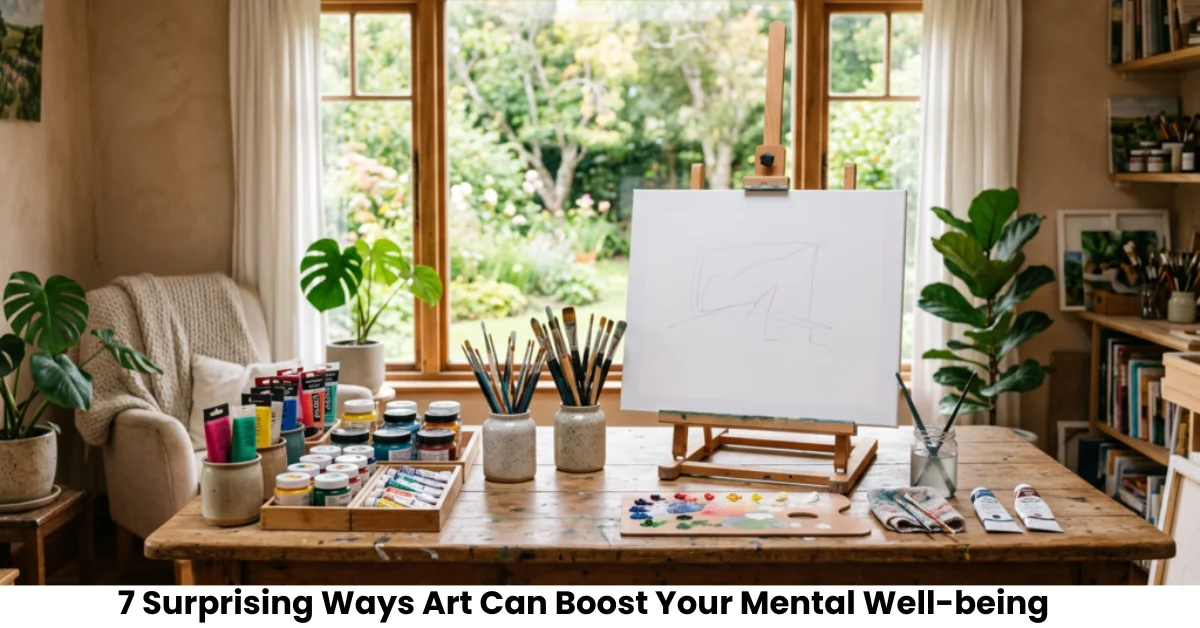
A bright welcoming home art space with paints, brushes, and a canvas on a wooden table, natural light streaming through a window
1. Paint by Numbers Dramatically Lowers Your Stress Hormones
Cortisol is the body’s primary stress hormone, and chronically elevated levels are linked to anxiety, sleep problems, and poor immune function. The good news: art-making brings it down fast.
A landmark Drexel University study found that 75% of participants experienced measurably reduced cortisol levels after just a 45-minute art session — and the results held regardless of prior artistic experience. A 2021 study published in the Journal of the American Art Therapy Association found that even 20 minutes of art-making produced significant cortisol reductions.
Paint by numbers is particularly well-suited to capturing these benefits. The numbered, structured format removes the decision fatigue and blank-canvas anxiety that stops many people from starting. There is no wrong move — each section has a designated color, and your only job is to fill it in. Starting with a custom paint by numbers kit is one of the lowest-barrier ways to experience these cortisol-lowering benefits at home, with no artistic skill required.
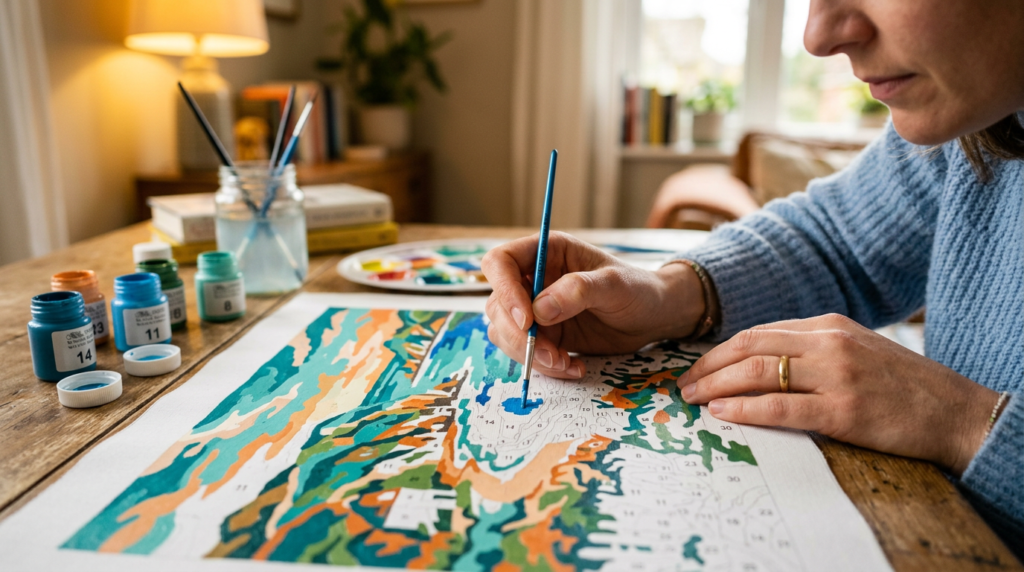
A person sitting calmly at a table painting a detailed paint-by-numbers canvas, warm home lighting, close-up of hands and brush
2. Art Puts Your Brain into a Powerful “Flow State”
Psychologist Mihaly Csikszentmihalyi spent decades studying peak human experience and identified a mental state he called “flow” — a condition of total absorption where self-consciousness and worry simply disappear. Athletes describe it as being “in the zone.” For most of us, it is one of the most reliably pleasant mental states available.
During flow, activity in the amygdala — the brain’s fear and anxiety center — decreases noticeably. At the same time, the prefrontal cortex, which governs focus and problem-solving, becomes more active. The result is a quieting of rumination and a sharpening of present-moment attention.
Painting is one of the most accessible ways to reach flow, and structured formats like paint-by-numbers are especially effective. Each numbered section gives the brain a clear micro-goal to complete, keeping it engaged just enough to prevent distraction without tipping into frustration. Research confirms that entering flow regularly trains the brain to self-regulate — a foundational skill for emotional resilience.
3. Creative Activity Triggers the Same Feel-Good Chemicals as Exercise
Many people know that exercise releases endorphins. Fewer realize that making art activates the same core set of mood-regulating neurochemicals: dopamine, serotonin, oxytocin, and endorphins.
Every time you complete a section of a painting, your brain releases a small dopamine reward. Unlike the fleeting spikes triggered by social media notifications, these dopamine hits are tied to genuine progress and a growing sense of mastery — which means they build rather than deplete over time.
A large-scale 2024 study published in Frontiers in Public Health, which tracked over 7,000 UK adults, found that creative activities were associated with significantly greater happiness and life satisfaction. Remarkably, the positive impact of regular crafting on the sense that “life is worthwhile” exceeded the impact of employment status — a finding the researchers themselves described as striking. Neurobiological research further suggests that creative engagement modulates serotonin levels and even reduces inflammatory immune responses, pointing to benefits that extend well beyond mood.
4. Painting Works Like Mindfulness Meditation — and It’s Easier
Mindfulness is well-evidenced as a tool for reducing stress and anxiety, but many people find traditional meditation frustrating. Racing thoughts, restlessness, and the pressure to “clear your mind” cause a significant portion of beginners to give up quickly.
Painting bypasses this problem. The core requirement of mindfulness — focused, non-judgmental attention on the present moment — happens naturally when you are matching paint colors to numbered sections, watching shapes emerge on canvas, and tracking the slow progress of a finished piece. Your attention is anchored without effort.
The data support this equivalence. Studies show that 75% of people who participated in art therapy reported decreased anxiety, and 77% reported improved overall psychological health. Remarkably, engagement with art therapy has been associated with a 62% increase in self-reported mindfulness and present-moment awareness. If conventional meditation has never clicked for you, a hands-on creative task may deliver the same mental reset through a different door.
5. Viewing Art Reduces Stress — Even When You’re Not Creating It
You don’t have to hold a brush to benefit from art. A 2025 study from King’s College London, co-funded by the Art Fund, found that viewing original art in a gallery reduced participants’ cortisol levels by 22%. But the biological effects went further: pro-inflammatory markers IL-6 dropped by 30% and TNF-α by 28%, effects that led the researchers to describe the experience as a “cultural workout for the body.” In a way, it has a suiting effect in the same way that a well-designed, custom room would.
Even viewing reproductions rather than originals produced an 8% cortisol reduction — still a meaningful physiological shift. A broader scoping review published in PMC in 2021 found that across almost every study measuring self-reported stress, viewing artwork resulted in significant decreases.
This means that spending a few minutes looking at paintings modern art — whether on a gallery wall or on your screen — can produce real, measurable changes in your body’s stress response. No appointment, no commute, and no artistic skill required.
Person relaxed on a couch, scrolling through colorful abstract artworks on a tablet, soft lighting, calm expression
6. Regular Creative Engagement Protects Your Brain Long-Term
The mental health benefits of art are not just immediate — they compound over the years. A joint study from Purdue University and Boston University found that creativity independently reduced mortality risk, separate from factors like general intelligence or personality traits. People who engage in creative practice consistently maintain greater integrity in their neural networks as they age.
Fine motor activities like painting also reinforce hand-eye coordination and motor pathways, which are particularly valuable for older adults. Creative pursuits that require sustained focus strengthen working memory and attentional control — capacities that tend to erode without regular use.
The WHO’s observation that the COVID-19 pandemic drove a 25% increase in global anxiety and depression highlighted just how fragile mental health can be under prolonged stress. Creative hobbies have been consistently cited among the most effective recovery tools, precisely because they combine focus, a sense of achievement, and — when pursued with others — social connection. Think of regular painting practice as a gym session for your brain: one that also produces something you can hang on the wall.
7. Finishing a Painting Builds Real Emotional Resilience
There is something specific and powerful about completing a creative project. Psychologists call it a “mastery experience” — concrete, visible evidence that you set out to do something and succeeded. These experiences are among the most reliable foundations of self-efficacy, the deep-seated belief that you can meet challenges.
Art therapy research documents this effect clearly: 77% of participants reported improved self-esteem and communication skills following art therapy sessions. Among veterans, 76% reported significant improvements in post-traumatic growth — the ability to find meaning and rebuild confidence after adversity. A 2025 UK survey found that 20% of people who engage with art regularly cite increased confidence and self-esteem as a direct benefit.
Every painting you finish, whether a complex landscape or a simple structured kit, adds to a personal record of capability. That record is cumulative. The more you build it, the more resilient you become — not just as a creative, but as a person.
Person proudly holding up a completed colorful painting, smiling, warm natural light, sense of accomplishment
The Bottom Line
The research is consistent and growing: art is not a luxury or a distraction from mental health — it is a legitimate tool for it. Whether you are actively painting and experiencing the flow state and dopamine rewards that come with it, or simply taking a few quiet minutes to view beautiful work, the effects on stress, mood, cognition, and resilience are real and measurable.
The best part is that none of this requires talent. A 45-minute session delivers cortisol benefits whether you are a professional painter or someone who has never touched a canvas. Even 20 minutes counts. If you are looking for the lowest-friction way to begin, a structured kit removes every barrier — no blank canvas, no art supplies to source, no skill prerequisite. Start small, stay consistent, and let the science do the rest.
Disclaimer: WellbeingDrive provides health information for educational purposes only. Do not use this content as a substitute for professional medical advice. Consult your doctor before making health related decisions.