
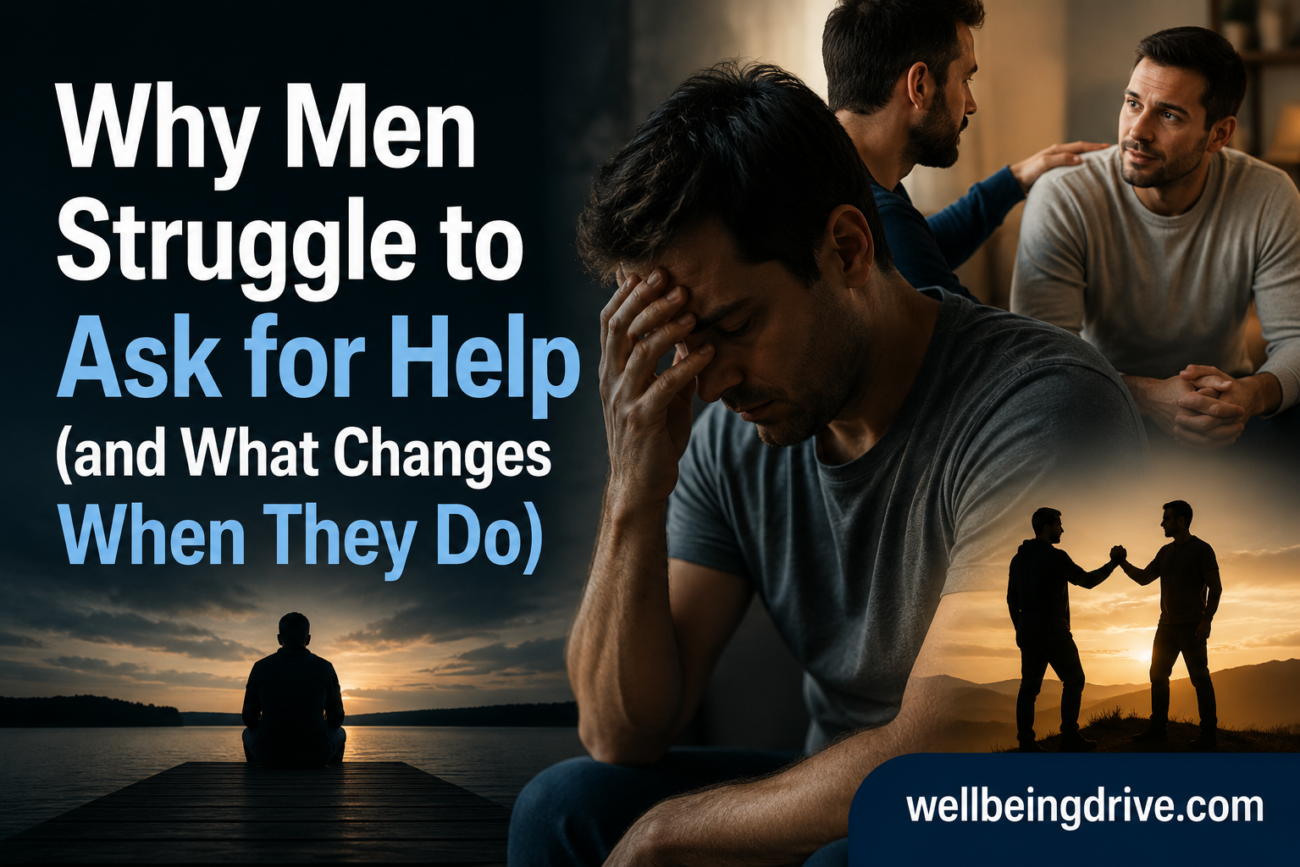
A lot of men have a version of the same story. Things get hard, quietly. The stress builds, or the drinking creeps up, or a low mood settles in and won’t lift. And instead of telling anyone, they do what they’ve always done. They handle it. Alone.
They keep showing up to work, keep taking care of everyone else, keep saying “I’m good” when someone asks. From the outside, nothing looks wrong. Inside, they’re carrying something heavy with no one to help hold it, because somewhere along the way they learned that asking would make them less of a man.
It won’t. But that lesson runs deep, and it costs more than most men realize.
Where the silence comes from
Most men weren’t taught to ask for help. They were taught the opposite.
Be strong. Don’t cry. Provide. Handle your business. Boys hear these messages early, and by adulthood they’ve hardened into a rule: needing help means you failed at being a man. So when something’s wrong, a lot of men don’t reach out. They grit their teeth and wait for it to pass, or they find a private way to numb it.
This isn’t a character flaw. It’s conditioning, and it’s nobody’s personal fault. But understanding where the silence comes from is the first step to breaking it.
What the silence costs
Carrying it alone doesn’t make the problem go away. It sends it underground, where it tends to get worse.
For a lot of men, the private coping tool is alcohol or drugs. NIDA reports that men are more likely than women to use almost all types of illicit drugs, and that their drug use is more likely to end in an emergency room or an overdose. Men also drink more heavily on average. It makes a sad kind of sense: if you can’t say you’re struggling, you look for something that quiets the struggle without a conversation.
The hardest number is this one. The CDC reported that in 2024, men died by suicide at nearly four times the rate of women. Men aren’t hurting less than women. They’re often just hiding it longer, until it becomes a crisis instead of a conversation.
Why men don’t reach out, even when they’re drowning
Even when a man knows something’s wrong, a wall of reasons keeps him quiet.
He doesn’t want to be judged. He doesn’t want to worry his family. He tells himself it’s not that bad, or that real men don’t need therapy, or that he should be able to fix this himself. The numbers show how common that silence is. Among adults under 45, CDC data found that only about 18% of men had received any mental health treatment in a recent year, compared with roughly 29% of women. Men are struggling at similar rates. They’re just far less likely to say so out loud.
What changes when a man finally asks
Here’s the part that doesn’t get talked about enough. When a man does reach out, something shifts, often faster than he expected.
The first thing is relief. Putting the weight into words, even once, even clumsily, loosens its grip. The second is connection. Most men who open up discover they’re not the only one, that other guys have been through the same thing and come out the other side. There’s a reason recovery for men so often happens shoulder to shoulder with other men who get it. The isolation was half the problem, and being known starts to undo it.
Then things start to actually improve. Not overnight, but they move. The problem that felt permanent turns out to be workable once he’s not facing it alone.
What this can look like
Picture a man who had it all together on paper. Good job, family, the respect of everyone around him. What nobody knew was that he’d been drinking himself to sleep for years to quiet an anxiety he never told a soul about.
He finally cracked and told his brother, braced for judgment. His brother just said, “Why didn’t you tell me sooner?” That one conversation broke something open. Reaching out for real help stopped feeling like surrender and started feeling like the first strong thing he’d done in a long time. The relief of not carrying it alone was almost physical.
When and how to reach out
You don’t have to make a big declaration. You just have to tell one person the truth, or make one phone call.
If you’re drinking or using to cope, if you’ve felt low or on edge for weeks, or if you’ve had thoughts of not wanting to be here, those are signals to reach out now, not later. Tell a friend. Call a doctor. If it helps to start somewhere built for men specifically, a program offering men’s addiction treatment in Arkansas can meet you where you are, no judgment attached.
Asking for help isn’t the opposite of being strong. It’s one of the strongest things a man can do, because it takes more courage to say “I need help” than to keep pretending you don’t.
If you’re in crisis or having thoughts of suicide, call or text 988 to reach the Suicide and Crisis Lifeline. To find treatment, SAMHSA’s national helpline at 1-800-662-HELP (4357) is free, confidential, and open every day.
The first word
The hardest part is the first sentence, the one where you admit out loud that you’re not okay. Everything gets easier after that, not because the problem vanishes, but because you’re finally not the only one carrying it. Say the sentence. The rest is more survivable than the silence.
Sources
- Centers for Disease Control and Prevention (CDC), Suicide Data and Statistics (2024 — male suicide rate) — https://www.cdc.gov/suicide/data/index.html
- Centers for Disease Control and Prevention / NCHS, Mental Health Treatment Among Adults Ages 18–44 (2021 — treatment by sex) — https://www.cdc.gov/nchs/products/databriefs/db444.htm
- National Institute on Drug Abuse (NIDA), Sex and Gender Differences in Substance Use — https://nida.nih.gov/publications/research-reports/substance-use-in-women/sex-gender-differences-in-substance-use
Disclaimer: WellbeingDrive provides health information for educational purposes only. Do not use this content as a substitute for professional medical advice. Consult your doctor before making health related decisions.