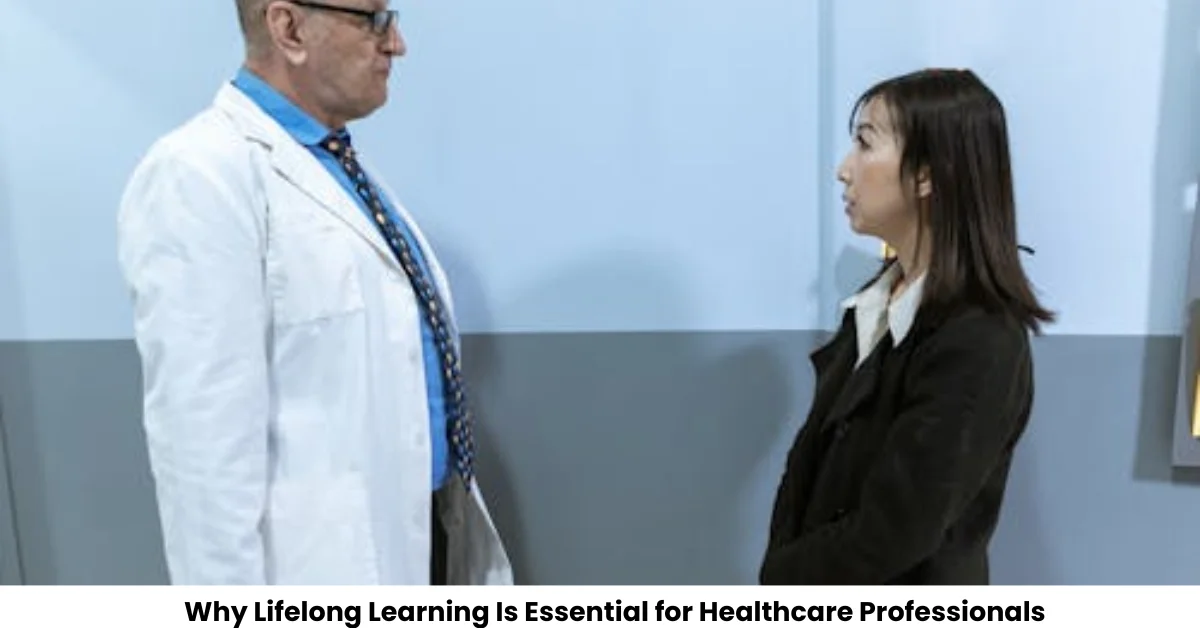
Have you ever been a patient and wondered whether your nurse or doctor was truly up-to-date? It’s not a cynical thought—it’s a reasonable one. In a world where medical breakthroughs, policy shifts, and tech disruptions happen weekly, healthcare professionals who don’t keep learning risk becoming liabilities instead of life-savers.
Let’s explore why lifelong learning is not just a feel-good idea but a professional necessity in today’s healthcare world.
Medicine Doesn’t Stand Still, and Neither Should You
Healthcare is one of the fastest-evolving industries in the world. From AI diagnostics to gene-editing therapies, the landscape shifts dramatically every year. Consider the COVID-19 pandemic: treatments changed in real-time, protocols were rewritten, and professionals had to adapt overnight. What worked last year might be obsolete now, and what’s cutting-edge today may be disproven tomorrow.
For doctors, nurses, technicians, and even administrators, lifelong learning isn’t a perk—it’s the price of relevance. Patients expect competent care rooted in the latest research, not outdated practices passed down like family recipes. Whether it’s understanding new drug interactions or interpreting data from wearables, ongoing education ensures that healthcare workers aren’t relying on knowledge from 1998 to treat problems in 2026.
From the Bedside to the Browser: Learning Is Getting More Accessible
The good news? Lifelong learning no longer requires signing up for expensive, time-consuming, in-person degrees. The explosion of online education means healthcare professionals can keep up while still holding down a shift.
For nurses in particular, affordable RN to BSN online programs offer a practical way to advance their careers without stepping away from patient care. Take William Paterson University’s online RN to BSN program. It allows working nurses to complete their Bachelor of Science in Nursing on their own schedule, combining affordability with academic credibility. Programs like these bridge the gap between clinical experience and leadership readiness, blending practice with policy, and theory with real-world application.
When upskilling can happen in pajamas between night shifts, the barrier to entry becomes more of a speed bump than a roadblock. It’s never been easier to stay current—so the question isn’t can you keep learning, but will you?
New Tech, New Rules
Let’s talk about robots. And not just the surgical kind. Artificial intelligence is transforming everything from diagnostics to administrative workflows. But AI isn’t plug-and-play magic—it’s a tool that requires human oversight, interpretation, and ethical boundaries. Without continuous learning, healthcare workers may either misuse these tools or reject them entirely out of confusion or fear.
Then there’s electronic health records (EHRs), telehealth platforms, and remote patient monitoring. Each comes with its own software quirks, data protocols, and compliance issues. A nurse who hasn’t updated their tech fluency might feel like they’re practicing in a foreign country—fluent in compassion but lost in interface navigation.
As healthcare leans more heavily on automation, those who don’t evolve risk becoming functionally illiterate in their own field. Lifelong learning helps professionals speak the language of innovation before that language leaves them behind.
Career Paths Aren’t Linear Anymore
The days of getting one degree and retiring forty years later at the same job are, for most, gone. Healthcare professionals today are pivoting: from bedside to boardroom, from hospital to startup, from clinical to policy roles. Each transition requires new knowledge, new certifications, and often, new mindsets.
A physical therapist might move into healthcare tech. A nurse could become a patient advocate. A physician might launch a biotech company. None of these shifts are possible without a foundation of continual learning and curiosity.
In a gig-driven, project-based economy, adaptability isn’t just nice—it’s non-negotiable. Lifelong learning is your ticket to professional reinvention.
Burnout Is Real—and Learning Can Help Prevent It
Ironically, one of the most overlooked benefits of lifelong learning is its power to protect against professional stagnation and burnout. Routine can be comforting, but over time, it can also become suffocating. The sense of discovery that fuels most healthcare workers at the start of their careers can fade without regular intellectual challenge.
Engaging in new learning—whether it’s exploring leadership, teaching, policy, or a new specialty—can reignite that sense of purpose. It provides direction and novelty, two antidotes to the emotional fatigue that plagues many in the profession today.
Instead of seeing learning as “one more thing to do,” more healthcare workers are reframing it as “the thing that keeps me going.” Because sometimes the best form of self-care isn’t a spa day—it’s enrolling in a course that reminds you why you joined the field in the first place.
Healthcare isn’t just about treating illness. It’s about meeting people where they are—technologically, emotionally, and culturally. And since people keep changing, so must the professionals who serve them. Lifelong learning is not a buzzword; it’s a lifeline—for practitioners and patients alike.
The white coat might stay the same. The knowledge underneath it can’t afford to.
Disclaimer: The content on Wellbeingdrive is for informational purposes only and not a substitute for professional advice. Always consult a qualified expert for health concerns.