
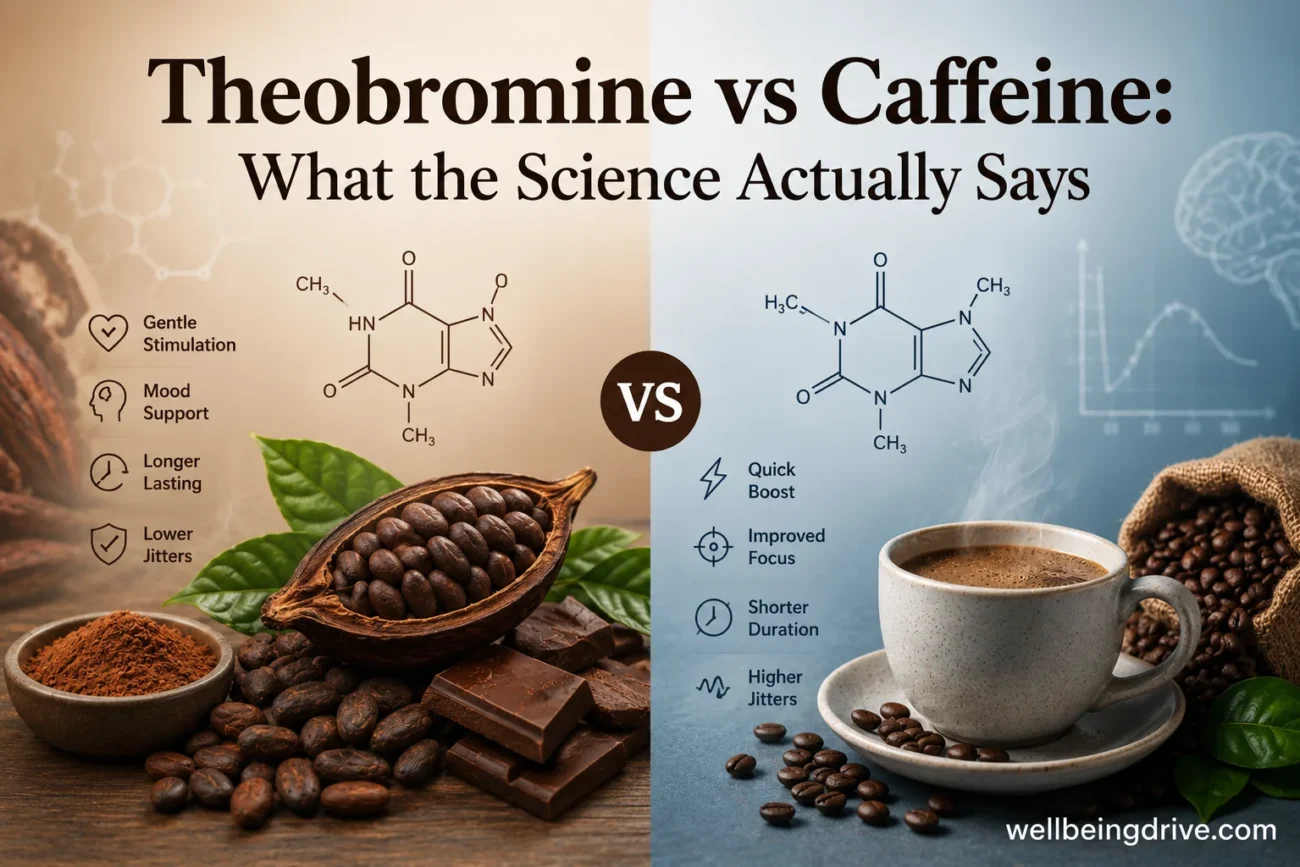
Theobromine vs Caffeine: Two Compounds From the Same Plant, With Very Different Jobs
They share a chemical family, appear together in cacao, and your body even converts one into the other. But what they do once they are inside you is genuinely different — different timelines, different organs, different side effects, and different reasons to care about each one.
What They Are and How They Are Related
Theobromine and caffeine are both methylxanthine alkaloids — compounds produced by plants, belonging to the same chemical family, acting through overlapping mechanisms in the body. They share a purine base structure and both work primarily by blocking adenosine receptors, which is the mechanism that reduces feelings of tiredness and increases alertness.
The structural difference between them is a single methyl group. Caffeine carries three methyl groups attached to its xanthine core, giving it the chemical name 1,3,7-trimethylxanthine. Theobromine carries two, making it 3,7-dimethylxanthine. That single additional group changes almost everything about how potently each compound crosses into the brain, how quickly the body processes it, and how long its effects last.
The relationship goes further than structure. Your liver metabolises caffeine into three compounds — and one of them is theobromine. Approximately 12 percent of any caffeine you consume is converted to theobromine during metabolism. So when you drink coffee, you are not just consuming caffeine — you are generating a small amount of theobromine inside your own body as a byproduct of processing it.
Caffeine is primarily a brain stimulant — fast, sharp, and short-lived. Theobromine is primarily a cardiovascular and respiratory compound — slower to arrive, longer-lasting, and working mostly outside the brain.
How Each One Works in the Body
Both compounds block adenosine receptors. Adenosine is a neurotransmitter that accumulates throughout the day and produces drowsiness — it is the chemical signal that tells your brain it is tired. By sitting in the receptor binding sites without activating them, both theobromine and caffeine effectively mute that fatigue signal.
Where they diverge is in where those receptors are located and how effectively each compound reaches them.
Speed, Peak, and Duration — the Timeline Numbers
The practical difference most people care about is not the chemistry — it is how the experience feels across time. And on this dimension, the two compounds diverge sharply.
The half-life difference has a meaningful practical consequence. If you drink coffee at noon, half the caffeine is gone by roughly 5 pm — but the other half is still active, which is why afternoon coffee disrupts sleep for many people. Theobromine consumed at the same time would still be at full concentration by 5 pm, declining slowly through the evening rather than falling sharply. This is why ceremonial cacao practitioners typically recommend consuming it before 2 pm.
Side by Side — Effects, Benefits, and Drawbacks
| Property | Caffeine | Theobromine |
|---|---|---|
| Primary action site | Central nervous system (brain) | Peripheral system (heart, blood vessels, airways) |
| Onset speed | 30 to 45 minutes | 2 to 3 hours |
| Half-life | 3 to 5 hours | 6 to 12 hours |
| Alertness effect | Strong and fast — well documented | Mild — limited blood-brain barrier crossing |
| Blood pressure | Transiently raises blood pressure | May lower blood pressure via vasodilation |
| Heart rate | Can increase significantly | Mild increase in some individuals |
| Bronchodilation | Mild | More pronounced — studied for respiratory use |
| Jitters / anxiety | Common at higher doses | Not typically reported |
| Sleep disruption | Significant — especially with afternoon use | Possible with late consumption due to long half-life |
| Energy crash | Common as levels drop sharply | Gradual decline — crash less reported |
| Tolerance buildup | Well established — effects diminish with daily use | Less studied — appears lower risk due to weaker binding |
| Primary food source | Coffee, tea, energy drinks | Cacao, dark chocolate, small amounts in tea |
What the Clinical Research Actually Shows
The research picture on these two compounds is noticeably unequal. Caffeine has decades of rigorous clinical investigation behind it. Theobromine has significantly less, which means some of its attributed benefits are better supported than others.
Much of what circulates online about theobromine’s mood and focus benefits is extrapolated from its known properties and from studies on cacao as a whole — not from controlled theobromine-only trials. The PubMed study showing theobromine alone failed to affect mood or vigilance is one of the few direct human trials on the compound. Its cardiovascular benefits are better evidenced than its cognitive ones. This does not mean the cognitive claims are wrong — it means the evidence base is thinner than the confident language used to describe them often suggests.
Where Each Compound Is Found in Food
| Food / Drink | Theobromine (per 100g or 240ml) | Caffeine (per 100g or 240ml) |
|---|---|---|
| Raw cacao powder | ~2,000 mg | ~230 mg |
| Dark chocolate (70–85%) | ~250 mg | ~40–60 mg |
| Milk chocolate | ~60 mg | ~20 mg |
| Brewed coffee (240ml) | Negligible (formed as metabolite) | ~95–200 mg |
| Black tea (240ml) | ~3–10 mg | ~47 mg |
| White chocolate | Trace amounts | Trace amounts |
| Yaupon holly tea (240ml) | Moderate — contains both naturally | ~30–60 mg |
The cacao numbers explain why dark chocolate produces a noticeably different experience from coffee despite both being stimulant-containing foods. A 40g serving of good dark chocolate delivers roughly 100mg of theobromine alongside 20 to 25mg of caffeine. You get a gentle, slow-building alertness from the caffeine, followed by the broader cardiovascular and mood effect from the dominant theobromine — a layered experience that coffee’s caffeine-only profile does not replicate.
The Combination: What Happens When Both Are Present
Cacao is the most studied natural combination of the two. Its roughly 10:1 ratio of theobromine to caffeine is not incidental — it appears to represent a genuinely synergistic balance that each compound alone does not achieve.
Theobromine exhibits a slower onset and longer half-life than caffeine, which may explain its reduced but sustained stimulatory effects.
Benowitz — Clinical Pharmacology & Therapeutics, as cited in multiple compound reviewsThe cardiovascular synergy is particularly worth noting. Caffeine transiently raises blood pressure by constricting blood vessels. Theobromine has the opposite vascular effect — it dilates blood vessels. When consumed together in cacao’s natural ratio, these effects partially counterbalance each other, producing a cardiovascular response more moderate than either compound in isolation. The 2024 endothelial function study that found cacao’s natural methylxanthine combination outperforming isolated caffeine is consistent with this picture.
For those interested in combining these compounds deliberately, the evidence points toward cacao as the most sensible natural source — it delivers them in a studied ratio with additional flavanols and polyphenols that have their own cardiovascular benefits. Adding L-theanine to caffeine is a well-researched pairing that reduces jitter-producing effects while maintaining alertness. According to the PubMed double-blind study on theobromine and mood, the combination of caffeine and theobromine together increased feelings of alertness more than either compound alone — providing the most concrete clinical data available on their combined use.
Who Each Compound Is Better Suited For
Given everything above, the practical question is which compound is more appropriate depending on what someone is trying to achieve — and what their individual tolerance looks like.
The bigger picture is that neither compound is universally better than the other — they do different things and are suited to different goals. Caffeine’s research base is deeper and its alertness effects are better established. Theobromine’s cardiovascular and respiratory effects are real and documented, even if its direct cognitive claims are often overstated in popular coverage. For readers wanting to explore the broader evidence on methylxanthines in food, the NIH review on the relevance of theobromine in cocoa’s health effects is one of the more thorough summaries available in a readable format.
Frequently Asked Questions
Both are methylxanthine alkaloids that block adenosine receptors. Caffeine has three methyl groups, peaks in 30 to 45 minutes, has a half-life of 3 to 5 hours, and strongly stimulates the central nervous system. Theobromine has two methyl groups, peaks in 2 to 3 hours, has a half-life of 6 to 12 hours, and works primarily in the peripheral system — widening blood vessels and relaxing airway muscles rather than directly stimulating the brain.
Weaker as a central nervous system stimulant. Theobromine has 2 to 3 times lower affinity for adenosine receptors than caffeine and crosses the blood-brain barrier poorly. A double-blind PubMed study found theobromine failed to consistently affect mood or vigilance at any dose, while 100mg caffeine significantly reduced fatigue and increased alertness. However, theobromine produces stronger vasodilatory and bronchodilatory effects than caffeine in the peripheral system.
No. They are different compounds with different structures and effects. Dark chocolate contains both — roughly 250mg of theobromine per 100g alongside 40 to 60mg of caffeine, making theobromine the dominant stimulant in chocolate. Interestingly, your liver converts approximately 12 percent of any caffeine you consume into theobromine as a metabolite, so every coffee drinker produces a small amount of theobromine internally.
No. Jitters, anxiety, and sleep disruption are associated with caffeine’s strong central nervous system stimulation. Theobromine’s limited blood-brain barrier penetration and much weaker adenosine receptor binding mean it does not produce the same overstimulation effects. Its effects develop more slowly and persist longer without a sharp crash. This is why people who are sensitive to caffeine sometimes tolerate cacao and dark chocolate better than coffee.
Yes, and they occur naturally together in cacao at a roughly 10:1 ratio. A 2024 study found cacao’s natural methylxanthine combination improved endothelial function more effectively than isolated caffeine alone. Clinical data also shows the combination of both compounds increased feelings of alertness more than either alone. Theobromine’s vasodilatory effects may partially counterbalance caffeine’s transient blood pressure elevation when consumed together.
Cacao is by far the richest source — raw cacao powder contains approximately 2,000mg of theobromine per 100g. Dark chocolate contains around 250mg per 100g. Milk chocolate contains considerably less at around 60mg per 100g. Smaller amounts are found in tea leaves, guarana, and yaupon holly. Coffee contains negligible theobromine directly, though the body converts approximately 12 percent of consumed caffeine into theobromine during metabolism.
Disclaimer: This article is for informational purposes only and does not constitute medical or dietary advice. Individual responses to stimulant compounds vary. People with cardiovascular conditions, anxiety disorders, or sleep problems should consult a healthcare provider before significantly changing their intake of caffeine or theobromine-containing foods. Research references include the PubMed double-blind theobromine study, and NIH review on theobromine in cocoa.
Disclaimer: WellbeingDrive provides health information for educational purposes only. Do not use this content as a substitute for professional medical advice. Consult your doctor before making health related decisions.